

Guide to Salesforce CRM Implementation Services in 2026
In 2026, the pace of digital change in Ireland and the UK is relentless. Businesses seek not only scalable growth but also a real competitive advantage in a landscape defined by innovation and compliance.
This comprehensive guide is designed to demystify Salesforce CRM implementation services, arming you with the knowledge needed for seamless adoption, smooth integration, and measurable return on investment. Whether you are evaluating your first CRM or looking to optimise an existing platform, you will find step-by-step insights tailored to your needs.
Explore the latest trends, key benefits, common pitfalls, practical implementation steps, and expert tips for choosing the right partner. By the end, you will be equipped with future-ready strategies to maximise your Salesforce ROI and drive lasting business success.
The Evolving Landscape of Salesforce CRM in 2026
Salesforce continues to redefine digital transformation for Irish & UK enterprises in 2026. Rapid platform growth is fuelled by powerful new AI capabilities, advanced automation, and seamless integration features. These innovations are driving demand for Salesforce CRM implementation services that deliver tailored, industry-specific solutions.
Across the UK&I, organisations are prioritising CRM architectures that are AI-ready, scalable, and future-proof. Core trends shaping the landscape include AI-driven insights, the adoption of Agentforce, hyper-automation, and a sharper focus on data compliance. Over 80 percent of UK enterprises now consider Salesforce a critical business platform, reflecting its expanding influence.
Regulatory changes, such as updated GDPR requirements and stricter data residency rules, are impacting CRM adoption strategies. Financial services and healthcare sectors are leading the way, leveraging advanced Salesforce solutions to maintain compliance and enhance customer experience.
Selecting a Salesforce partner that keeps pace with platform evolution is essential. With Salesforce investing £6 billion to establish an AI hub in the UK, as detailed in their official investment announcement, organisations must choose partners who can harness these innovations for long-term success.

Core Benefits of Expert Salesforce CRM Implementation Services
An expert Salesforce implementation partner, like capeMBX, empowers organisations to unlock measurable value from their CRM investments. By aligning Salesforce’s extensive features with your business strategy, our services ensure you see tangible financial outcomes and improved operational efficiency.
Maximising ROI, Efficiency, and Customisation
With expert support, businesses benefit from streamlined processes, reduced manual effort, and automation of repetitive tasks. Customisation options allow Salesforce to fit your unique workflows and industry requirements, whether you operate in financial services, healthcare, or retail.
Seamless integration with existing legacy systems and marketing platforms is a core advantage. This ensures data flows smoothly across your organisation, supporting faster sales cycles and informed decision-making.
User Adoption, Scalability, and Long-Term Value
Comprehensive training and ongoing support drive high user adoption rates, making it easier for staff to embrace new tools. Scalable solutions mean your CRM can adapt as your organisation grows or faces new regulatory demands.
Many organisations report a 30% reduction in sales cycle time and a 25% improvement in customer retention after engaging Salesforce implementation services. For further strategies to maximise your ROI, see Stop Leaving Money on the Table.
Continuous updates, proactive health checks, and feature adoption help future-proof your investment. Ultimately, these services turn Salesforce from a cost centre into a powerful engine for sustainable growth.
Common Challenges and How Implementation Services Solve Them
Many Irish and UK organisations encounter hurdles when adopting Salesforce CRM. A lack of internal expertise, overburdened IT teams, and the complexity of legacy systems can all hinder progress. These issues often delay projects and impact overall business value.

Common challenges include:
Shortage of experienced Salesforce administrators
Limited resources for ongoing CRM management
Highly customised or outdated Salesforce environments
Difficulty keeping pace with new features and best practices
Inflexible contracts or high support costs
Inconsistent quality from current vendors
Irish and UK businesses, especially in regulated sectors, frequently struggle to retain Salesforce talent and maintain system health. An expert Salesforce partner can address these gaps with dedicated support, flexible engagement models, and proactive optimisation. Providers deliver tailored training, seamless integration, and continuous improvement, ensuring a smooth transition and measurable results.
For a deeper look at pitfalls to avoid, review the Common Mistakes in Salesforce CRM Implementation guide, which highlights issues like neglecting AI integration and over-customisation. Choosing the right partner helps turn these challenges into opportunities for growth and innovation.
Step-by-Step Guide to Salesforce Implementation in 2026
Embarking on a Salesforce CRM project in 2026 requires a structured, phased approach. Each stage is designed to address unique business requirements, regulatory needs, and the rapid pace of platform evolution. Here is a step-by-step guide to ensure your journey is seamless and future-proof.
1. Discovery & Strategic Planning
The first phase of a Salesforce project is all about alignment and clarity. Begin by analysing existing business processes, involving stakeholders from sales, marketing, and IT. Map your requirements to Salesforce capabilities, identifying any potential gaps.
A tailored roadmap ensures your CRM aligns with growth and compliance. For highly regulated sectors, such as finance, advanced security and audit trails are essential. Health checks can gauge readiness for AI features. For deeper insights, see Strategic Decisions for Salesforce Implementation.
2. Configuration & Customisation
Next, focus on configuring the environment to support your unique processes. Customise objects, workflows, and automation rules for efficiency. Leverage industry-specific modules like Sales Cloud or Service Cloud.
Retailers often integrate inventory and loyalty management features. Ensuring a clean, scalable architecture now prevents issues later. This step lays the groundwork for efficient growth and future enhancements.
3. Data Migration & Integration
A critical stage in a Salesforce project is migrating and integrating data securely. Plan the transition from legacy systems, prioritising data quality and compliance, especially with GDPR and data residency.
Carefully map and validate datasets. Integrate Salesforce with ERP, marketing automation, or analytics platforms. Healthcare providers, for example, must ensure sensitive patient data is handled with strict security throughout this process.
4. User Training & Change Management
For successful projects, comprehensive user training is vital. Tailor sessions for different user groups, develop clear documentation, and provide ongoing support.
Change management strategies help drive adoption and address resistance. Companies with structured onboarding often achieve over 90% user adoption, ensuring teams are confident and empowered to maximise CRM value.
5. Ongoing Support, Optimisation & AI Readiness
Continuous support is the final step in a successful Salesforce CRM project. Monitor system health, adopt new features proactively, and prepare for future AI and Agentforce integration.
Flexible managed services allow your CRM to scale with business needs. Businesses leveraging AI-powered insights for sales forecasting gain a competitive edge. Regular reviews and optimisations keep your Salesforce investment delivering results.
How to Choose the Right Salesforce Partner in 2026
Selecting the right Salesforce partner is crucial to unlocking long-term value and avoiding costly missteps. With increasing platform complexity and rapid technological change, your choice directly impacts ROI and user adoption.
Key criteria for partner selection include:
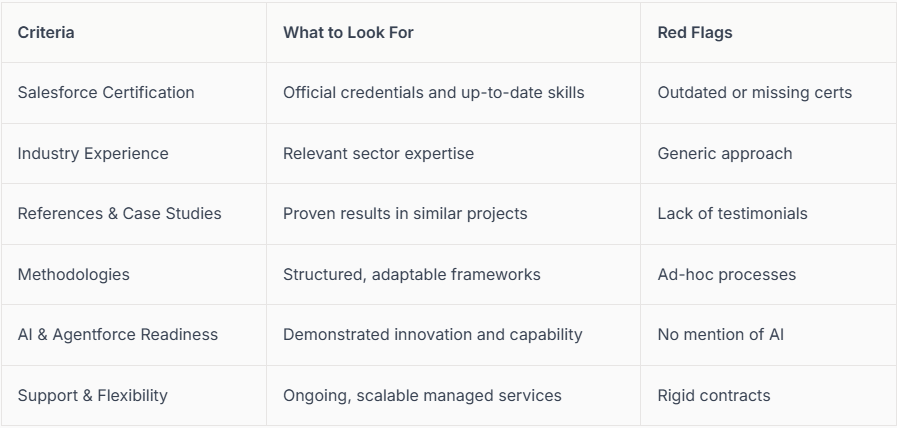
Transparent pricing and flexible engagement models are essential. Avoid providers with hidden fees or limited post-launch support, as these issues often lead businesses to switch partners due to frustration or lack of innovation.
Before committing to a Salesforce partner, ask about their change management approach, customisation capabilities, and success metrics. For a comprehensive checklist, refer to the 7 Questions When Choosing a Salesforce Partner to guide your evaluation process.
Engage in complimentary consultations and strategy sessions to assess cultural and technical fit. The right partner will prioritise your growth, compliance, and adaptability, ensuring your Salesforce investment remains future-ready.
Future-Proofing Your Salesforce CRM Investment
Adopting a forward-thinking approach to a Salesforce implementation project is essential for sustaining growth and maintaining a competitive edge in 2026. AI and automation are no longer optional; they form the backbone of modern CRM strategies, enabling organisations to respond quickly to market demands and regulatory shifts.
Building a flexible and scalable CRM architecture allows your business to adapt to evolving requirements. Regular system health checks, continuous training, and proactive support are vital. Investing in ongoing learning, such as following guidance from resources like the Salesforce Learning Guide 2026, ensures your team remains skilled and ready to leverage new features.
Managed services play a crucial role in maximising value. They provide continuous optimisation, smooth adoption of new Salesforce releases, and help businesses stay AI-ready. Choosing a service that offers proactive system reviews and upgrades will help future-proof your investment. Plus, executive sponsorship and collaboration across departments drive long-term CRM success.
As we’ve explored, getting Salesforce CRM implementation right in 2026 means more than just technology; it’s about aligning your goals, empowering your team, and setting a foundation for future growth.
If you’re ready to take the next step or want practical advice tailored to your business, you don’t have to navigate this journey alone. Let’s talk through your challenges, clarify your priorities, and map out a path to measurable results with an expert by your side.
Book a free consultation call and discover how capeMBX Consulting can help you turn Salesforce into a true engine for success.
