

How Much Does Agentforce Cost? A 2026 Pricing Guide for Irish & UK Businesses
Quick Answer: How Much Does Agentforce Cost in 2026?
Agentforce costs from €0 to €550+ per user, per month, depending on which of the three pricing models you choose. The cheapest entry point is Salesforce Foundations (free, with a starter Flex Credits allocation). The consumption model charges roughly €0.10 per action ($500 for 100,000 Flex Credits). The per-user add-on for internal employee agents starts at €125 per user per month, and bundled Agentforce 1 Editions start at €550 per user per month.
For most Irish and UK businesses we work with, the answer to "how much will it cost us specifically?" depends almost entirely on what you ask the agent to do, not on which tier you pick. We'll show you why below.
You can model your own numbers on the official Agentforce pricing calculator.

Why Agentforce Pricing Confuses People
Many of the Agentforce pricing articles online are six months out of date. The model has evolved fast, and Salesforce has done a lot of work to make it more flexible. Worth a fresh look.
We were in a Salesforce partner session in Dublin recently, where the message on pricing was direct: for new deployments, Flex Credits is the model Salesforce is recommending. The older per-conversation pricing still exists and still works for some scenarios, but it doesn't extend to voice, Slack, or Tableau, and Salesforce has been clear that future innovation is going into the Flex Credits model.
That's a useful signal. If you're evaluating Agentforce in 2026, here's what the pricing actually looks like, what it means for your budget, and how to choose the right structure for your use case.
The Three Agentforce Pricing Models Explained
Salesforce currently offers three commercial structures for Agentforce. Each has a clear use case, but they're not interchangeable. Picking the right one upfront makes a real difference to the knowledge, ortotal cost of ownership.
1. Flex Credits (the consumption pricing model)
This is the model Salesforce is steering most new deployments toward, and for good reason. It ties cost directly to value delivered.
$500 (roughly €465) buys a pack of 100,000 Flex Credits.
Each standard action costs 20 credits, or about €0.10.
Each voice action costs 30 credits, or about €0.15.
Only meaningful actions consume credits. A customer greeting and a polite sign-off cost nothing. Credits burn when Agentforce actually does something: updating a record, summarising a case, querying knowledge, executing a flow.
An "action" is one discrete step the agent takes. Pulling a customer record, sending an email, running a custom prompt, looking up an order. A single customer conversation might involve three to fifteen actions, depending on complexity.
Foundations, Salesforce's free tier for Enterprise Edition and above, includes a starting allocation of complimentary Flex Credits to get you off the ground. After that, you buy in $500 increments.
There are three buying structures inside Flex Credits worth knowing about:
Pre-purchase: Buy credits upfront. Drawn down as consumed.
Pay-as-you-go: Billed monthly in arrears based on actual usage. No commitment.
Pre-commit: Negotiated volume rate, monthly billing, with a true-up charge if you don't hit your committed volume.
Pay-as-you-go is a sensible place to start when you're still learning your action profile. Pre-commit is where the meaningful discounting happens, but it works best once you have a few months of real usage data to forecast against.
2. Per-Conversation Pricing ($2 per conversation)
Salesforce charges $2 (around €1.85) per "conversation," defined as any interaction within a 24-hour window. This was the original Agentforce model, and it remains available. It's a fit for organisations that want simple, predictable billing on customer-facing chat use cases and have no near-term plans for voice, Slack, or Tableau integration.
The maths can favour Conversations in one specific scenario: if your average interaction genuinely involves more than 20 actions, then 20 × €0.10 hits €2.00 and the flat rate breaks even or wins. For most well-designed agents that resolve queries in three to seven actions, Flex Credits will cost less.
One thing to plan for: you cannot run Flex Credits and Conversations in the same Salesforce org. You pick one. If your roadmap includes voice or Slack agents within the next 18 months, Flex Credits is the safer choice because Conversations doesn't extend to those channels.
3. Per-User Add-on Licenses (for internal employee agents)
This is the predictable-budget option for organisations deploying Agentforce internally. For example, an HR onboarding agent, a sales coach agent, or an internal IT helpdesk agent.
Agentforce for Sales / Service add-on: $125 (around €115) per user, per month. Unlimited Agentforce usage for the licensed employee.
Industry Cloud add-on (Financial Services Cloud, Health Cloud, etc.): $150 (around €140) per user, per month.
Agentforce 1 Sales / Agentforce 1 Service Editions: Starting at $550 (around €510) per user, per month. These are bundled editions that include 1 million Flex Credits per year, 2.5 million Data 360 Credits, plus Tableau Next, Slack Enterprise+, and the full predictive and generative AI stack.
The add-ons make sense when your employees will use the AI heavily enough that consumption pricing would exceed the flat fee. If your team is exploring, stay on Flex Credits and let the data guide you.

What Agentforce Actually Costs in the Real World
The numbers above are list price. Here's what they translate to in actual deployments.
A €465 Flex Credit pack will, on Salesforce's own published examples, qualify around 714 leads or resolve around 1,000 cases. That works out to roughly €0.65 per qualified lead or €0.50 per resolved case.
For context, a Salesforce customer called Foreo presented their service maths at the same Dublin partner session:
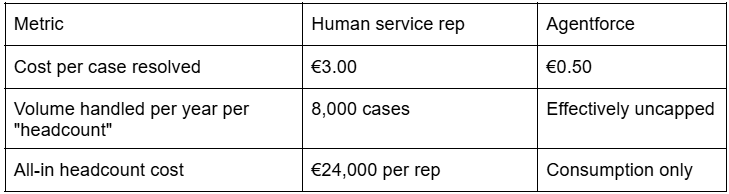
That's a 6x reduction in cost per case. Whether you can realise that depends on how you scope the agent, what you let it touch, and how much human oversight you keep in place. But the unit economics are real, and we're starting to see similar patterns in Agentforce deployments we're working on across Ireland and the UK.
Hidden Costs That Don't Show Up on the Pricing Page
Agentforce list pricing covers the agent. It doesn't cover everything needed to run one in production. Three line items most Irish and UK buyers underestimate:
Data Cloud is a separate line item. Agentforce needs Data Cloud to do anything meaningful. Salesforce is transparent about this on the pricing page, where Data 360 credits sit alongside Flex Credits. Foundations gives you a starter allocation, but production usage will exceed it quickly. Build it into your business case from day one rather than bolting it on later.
Salesforce Enterprise Edition or above is a prerequisite. Agentforce isn't available on Professional Edition. If you're on Essentials or Professional today, factor in the upgrade cost before the Agentforce sums.
Implementation isn't optional. Out of the box, Agentforce can answer basic questions and do simple lookups. To get the case-deflection numbers Salesforce quotes in customer stories, you need actions wired to your specific business processes, prompt templates designed for your tone of voice, and knowledge bases properly structured. Most Irish and UK organisations work with a Salesforce partner for this. Budget for it.
How to Estimate Your Specific Agentforce Cost
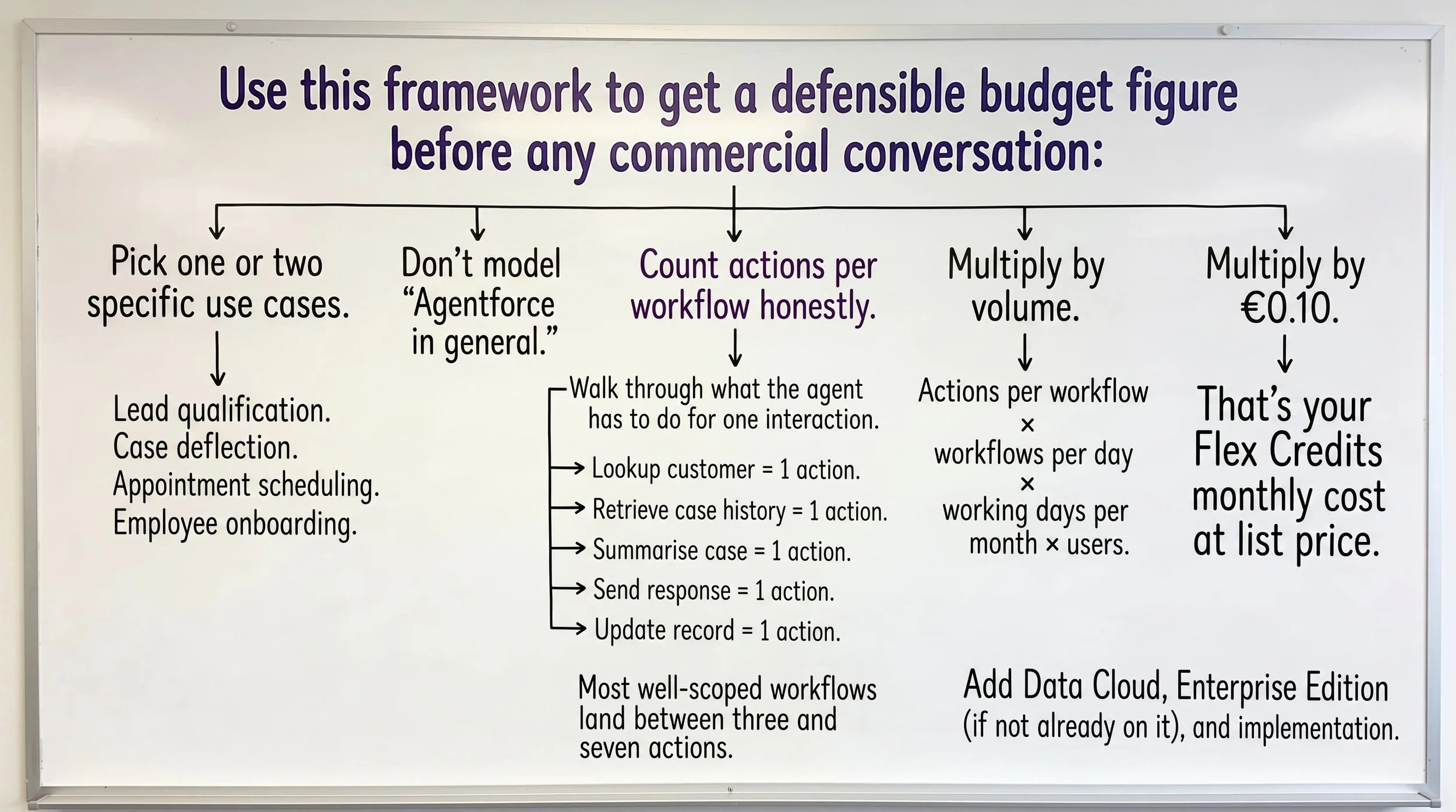
Use this framework to get a defensible budget figure before any commercial conversation:
Pick one or two specific use cases. Lead qualification. Case deflection. Appointment scheduling. Employee onboarding. Don't model "Agentforce in general."
Count actions per workflow honestly. Walk through what the agent has to do for one interaction. Lookup customer = 1 action. Retrieve case history = 1 action. Summarise case = 1 action. Send response = 1 action. Update record = 1 action. Most well-scoped workflows land between three and seven actions.
Multiply by volume. Actions per workflow × workflows per day × working days per month × users.
Multiply by €0.10. That's your Flex Credits monthly cost at list price.
Add Data Cloud, Enterprise Edition (if not already on it), and implementation.
Worked example: a mid-sized Irish service desk handling 200 cases per day, with each case taking five Agentforce actions to resolve. 200 × 5 × 22 working days × €0.10 = €2,200 per month in Flex Credits. Add Data Cloud and implementation, and the all-in monthly cost is closer to €3,500-€5,000 in the first year.
That's roughly the cost of one human service rep, handling roughly four times the volume.
Three Things Worth Thinking About Before You Sign
After sitting through Salesforce's own enablement and comparing it against client projects, three observations keep coming up.
One: the agent's job determines the cost, not the conversation length. A long, friendly, chatty interaction with no actions costs nothing. A two-line exchange that triggers ten record updates and an external API call costs ten times more. Design your agent around the actions you actually need it to perform, and you'll get the pricing right.
Two: Data Cloud is part of the picture, and it's a separate line item. We mentioned this above, but it bears repeating because it's the single most common surprise in our AI Readiness Check conversations.
Three: pick the model that matches your roadmap, not just your current use case. Conversations pricing is simpler today, but if you're going to want voice agents or Slack integration within 18 months, you'll need to migrate to Flex Credits to get there. Picking Flex Credits early avoids that switch cost.
How to Pick the Right Pricing Model
Use this as a rough decision tree:
Just exploring? Start with Salesforce Foundations. Free. Includes a starting Flex Credits allocation. Build one agent, see what an action actually costs you in practice.
Customer-facing, variable volume? Flex Credits, pay-as-you-go. No commitment, full transparency through the Digital Wallet.
Customer-facing, large scale, predictable volume? Flex Credits with a pre-commit agreement. Negotiate on volume.
Internal employee agents, heavy daily use? Per-user add-on at €115 (or €140 for industry clouds). Predictable monthly cost.
Enterprise-wide rollout across Sales and Service? Agentforce 1 editions. Bundled Flex Credits and Data 360 Credits at an effective discount.
The pricing model you pick at contract signing is easier to get right upfront than to unwind later. Spend the time to model your actions per workflow honestly, ideally with someone who has done a few of these and can challenge the assumptions.
What Action-Based Pricing Actually Means for ROI
The bigger story behind Flex Credits is that Salesforce has tied its commercial model directly to business outcomes. You pay when the agent does something useful. You don't pay for the AI to sit idle.
That's a meaningful change. Traditional per-seat software pricing charges regardless of whether anyone logs in. Action-based pricing only charges when the agent delivers measurable work. If you build agents that don't deliver, your bill stays small. If you build agents that do, the bill scales, and so does the value.
That alignment is rare in enterprise software, and it's one of the reasons we think the Flex Credits model is a genuinely good direction. It gives finance teams a defensible budget conversation: "We paid X, and the agent resolved Y cases or qualified Z leads." The maths is auditable, which is exactly what most CFOs we work with want from an AI investment. It also fits well with the way we approach Salesforce implementations through our BEACON methodology, where every project has clear value milestones tied to measurable outcomes.
Frequently Asked Questions About Agentforce Cost
How much does Agentforce cost per month?
For most Irish and UK businesses, expect to spend between €1,000 and €5,000 per month on Agentforce in the first year, depending on volume and use case. A small service team running 1,000 cases per month through Agentforce typically lands around €500 in Flex Credits, plus Data Cloud and platform costs. A mid-sized deployment with multiple agents and higher volume sits closer to €3,000-€5,000 monthly.
Is there a free version of Agentforce?
Yes. Salesforce Foundations, available to all customers on Enterprise Edition or above, includes Agent Builder, Prompt Builder, and a starting allocation of Flex Credits at no cost. It's designed for testing and pilots rather than production volume, but it's a genuinely useful place to start.
How much does one Agentforce action cost?
A standard Agentforce action costs roughly €0.10 (20 Flex Credits at the rate of $500 per 100,000 credits). A voice action costs roughly €0.15 (30 Flex Credits). Actions include updating records, summarising cases, querying knowledge, and executing flows.
Is Agentforce cheaper than hiring a service agent?
In most service use cases, yes. Salesforce customer Foreo reports €0.50 per case resolved through Agentforce versus €3.00 per case using human service reps, a 6x reduction. The economics depend heavily on how well the agent is scoped and how much human oversight you keep in place. For complex or high-empathy interactions, human reps still outperform on outcomes.
What's the difference between Flex Credits and per-conversation pricing?
Flex Credits charge per action the agent takes (€0.10 per action). Per-conversation pricing charges €1.85 per interaction within a 24-hour window, regardless of how many actions happen inside it. For most well-designed agents resolving queries in three to seven actions, Flex Credits costs less. Per-conversation only wins when the average interaction exceeds 20 actions. Crucially, per-conversation pricing doesn't support voice, Slack, or Tableau.
Do I need Data Cloud to use Agentforce?
Effectively, yes. Agentforce needs Data Cloud to access the structured and unstructured data it needs to function. Foundations includes a starting Data Cloud allocation, but production usage requires additional Data 360 credits, which are a separate line item from Flex Credits.
How can I estimate Agentforce cost for my business?
Use the official Salesforce Agentforce pricing calculator for a list-price baseline. For a more accurate Ireland or UK estimate that includes implementation, Data Cloud, and platform prerequisites, get in touch with capeMBX for a 30-minute scoping conversation.
Can I switch between Agentforce pricing models?
You can't run Flex Credits and Per-Conversation in the same Salesforce org at the same time. You can switch from one to the other at contract renewal, but mid-term switches require commercial renegotiation and can be disruptive. Pick the model that matches your 18-month roadmap, not just your current use case.
Get a Second Opinion Before You Sign
Most Agentforce deployments don't fail on the technology. They get stuck on the assumptions baked into the pricing model. Teams overcommit on Flex Credits before they understand their per-workflow action count. Or they buy per-user add-ons for users who never log in. Or they pick a model that fits today's use case but doesn't extend to where the roadmap is heading.
We work with Irish and UK clients to model their actual Agentforce workload before the commercial conversation, so the pricing model fits the use case rather than the other way around. That's part of our AI Readiness Check and feeds directly into the BEACON methodology we use for Salesforce implementations. If you're already on Salesforce and want a sense of whether your current setup is ready for Agentforce, our Salesforce Health Check is the right starting point.
If you're evaluating Agentforce in the next quarter and you want a second opinion on the pricing model before you commit, get in touch. Thirty minutes is usually enough to know whether what's on the table is the right shape for what you're trying to do.
All pricing in this article reflects Salesforce's published rates as of April 2026. Euro figures are approximate conversions from Salesforce's USD list prices and will vary with exchange rates. Verify current rates directly with Salesforce or via the Agentforce pricing calculator before any commercial decision.
