

Salesforce FSC for Wealth Management: Complete Guide
Most wealth managers we talk to have the same problem: their advisors are spending half their day in spreadsheets, email threads, and a CRM their team barely uses. They bought Salesforce to fix this. Many haven't. Here's what changes when Salesforce Financial Service Cloud (FSC) is implemented properly.
Salesforce FSC for wealth management addresses these challenges by providing an industry-specific platform that unifies client relationships, automates workflows, and delivers actionable insights. This purpose-built solution transforms the way wealth advisors engage clients, manage portfolios, and grow their businesses.
Understanding Financial Services Cloud's Core Architecture
The Financial Services Cloud platform represents a significant departure from standard CRM implementations. Built on Salesforce's Customer 360 foundation, it introduces an industry-specific data model designed around households, relationships, and financial accounts rather than generic business contacts.
This architecture enables wealth managers to visualise complex family structures, beneficiary relationships, and multi-generational wealth transfer scenarios. Unlike Sales Cloud, which focuses on opportunity pipelines, FSC for wealth management centres on financial accounts, goals, and life events.
Key Components of the Data Model
The platform organises information through several interconnected objects:
Household management for family groupings and relationship mapping
Financial accounts tracking portfolios, holdings, and performance
Revenue analysis, calculating advisor compensation and household profitability
Client goals linking objectives to investment strategies
Actionable referrals capturing opportunities within existing networks
Each component integrates seamlessly, creating a 360-degree view that advisors access through a single interface. This unified approach eliminates the data silos that plague traditional wealth management technology stacks.

Enhancing Advisor Productivity Through Automation
Wealth advisors spend excessive time on administrative tasks rather than client-facing activities. Salesforce FSC tackles this inefficiency through intelligent automation and streamlined workflows.
The platform's automation capabilities extend across client onboarding, compliance documentation, and portfolio reviews. Advisors configure workflow rules that trigger automatically based on client life events, market conditions, or regulatory deadlines.
Practical Applications for Wealth Management Firms
Consider how automation transforms daily operations:
Client onboarding: Pre-populate forms using existing household data, route documents for e-signature, and schedule welcome calls automatically
Portfolio monitoring: Generate alerts when holdings drift from target allocations or trigger rebalancing recommendations
Compliance tracking: Schedule periodic reviews, log client interactions, and maintain audit trails without manual data entry
Renewal management: Flag upcoming annuity maturities, policy renewals, or planned distributions months in advance
According to Salesforce's wealth management documentation, firms implementing these automation features report 25-30% increases in advisor capacity. That translates directly to more client meetings, increased assets under management, and improved client satisfaction scores.
Leveraging AI: Agentforce and Einstein
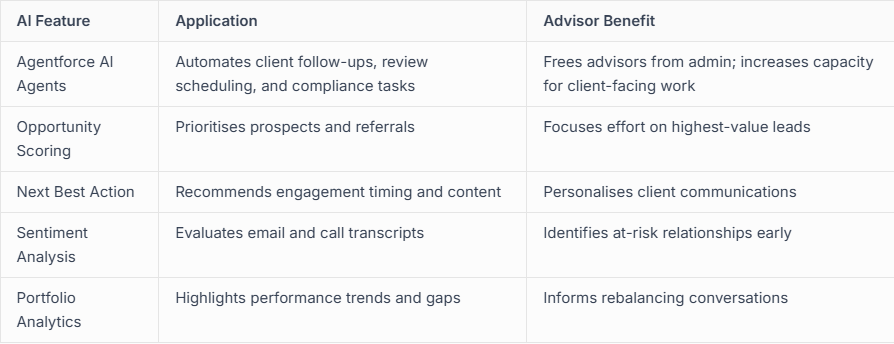
The integration of artificial intelligence separates modern platforms from legacy systems. Salesforce FSC embeds both Agentforce AI Agents and Einstein AI throughout the advisor experience, delivering autonomous task execution, predictive insights, and intelligent recommendations.
Agentforce brings autonomous AI agents that handle client follow-ups, schedule reviews, and surface compliance tasks without advisor intervention. Einstein Opportunity Scoring analyses historical patterns to identify which prospects most likely convert. Einstein Next Best Action suggests specific engagement strategies based on client profiles, recent interactions, and market conditions. Together, these capabilities represent the broader Agentforce capabilities now available across Salesforce products.
One thing worth saying plainly: most firms are nowhere near ready for autonomous AI agents. The advisors doing the most with Agentforce right now are using it for one or two specific, well-defined tasks, like scheduling follow-ups after a portfolio review. Not replacing workflows wholesale.
Start narrow. Prove value. Then scale.
Analytics dashboards surface real-time business metrics without requiring technical expertise. Advisors track asset growth, client acquisition costs, and referral patterns through customisable reports that update automatically as data changes.
Ensuring Compliance and Security
Financial services firms operate under stringent regulatory frameworks. Financial Services Cloud for wealth management addresses compliance requirements through built-in audit capabilities, permission controls, and data governance features.
The platform maintains comprehensive activity logs, documenting every client interaction, portfolio change, and system access event. These audit trails prove invaluable during regulatory examinations or internal compliance reviews.
Security Features for Financial Data
Protection mechanisms include the following:
Field-level encryption for sensitive financial information
Role-based permissions limit data access by user profile
Multi-factor authentication prevents unauthorised system entry
Data retention policies automating record-keeping requirements
Many firms transitioning from in-house systems initially worry about cloud security. However, Salesforce maintains certifications, including SOC 2, ISO 27001, and industry-specific standards, that exceed most internal IT capabilities.

Integration With Third-Party Systems
No wealth management firm operates on a single platform. Portfolio management systems, custodial platforms, financial planning software, and market data feeds must connect with the CRM.
Financial Services Cloud supports integration through APIs, middleware platforms, and pre-built connectors. The implementation process typically addresses connections to core systems during initial deployment.
Common integration patterns include:
Portfolio management systems: Synchronising holdings, transactions, and performance data
Document management: Linking client files stored in external repositories
Financial planning tools: Importing goal projections and scenario analyses
Marketing automation: Coordinating campaigns across email, social, and events
According to industry analysis, firms achieving the highest ROI integrate five or more external systems, creating a truly unified technology ecosystem.
Mobile Capabilities for Client Engagement
Modern clients expect digital interactions to match their consumer experiences. Salesforce FSC delivers through native mobile applications, enabling secure, anytime access to financial information.
The Salesforce mobile app provides advisors with full CRM functionality while meeting clients or attending industry events. They can access household profiles, review portfolios, update opportunities, and log activities from any location.

Client Portal Functionality
Beyond advisor tools, the platform supports branded client portals where households securely:
View consolidated portfolio positions and performance
Access statements, tax documents, and compliance disclosures
Schedule appointments and communicate with their advisor team
Update contact information and financial goals
These self-service capabilities reduce administrative burden whilst improving client satisfaction. Research from Financial Services Cloud implementations shows portal adoption correlates strongly with client retention rates.
Measuring Success Through Business Metrics
Implementing Salesforce Financial Services Cloud for wealth management requires clear success criteria. Forward-thinking firms establish baseline metrics before deployment and track improvements systematically.
Key performance indicators typically include:
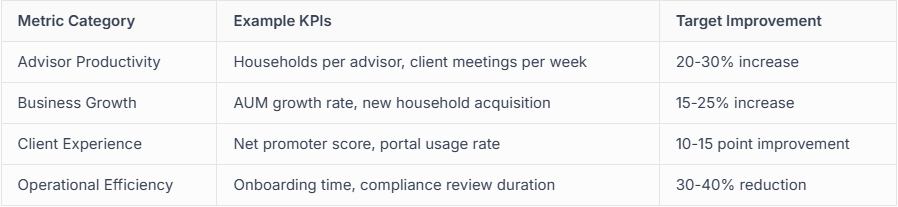
These metrics inform ongoing optimisation efforts. Firms using capeMBX and our BEACON methodology establish measurement frameworks during discovery phases, preventing the common pitfall of implementing technology without defined business outcomes.
Regular performance reviews identify opportunities for additional automation, refined workflows, or enhanced integrations. This continuous improvement approach ensures the platform evolves alongside business requirements rather than becoming a static system requiring future replacement.
Is Financial Service Cloud Right For Your Firm? (A Straight Answer)
FSC isn't for every wealth manager. If you have fewer than 10 advisors, you're probably better served by Sales Cloud with some custom configuration. FSC's value scales with complexity - household structures, multi-entity relationships, and regulatory reporting. The licensing costs are real. The implementation timeline is longer than a standard Sales Cloud project. Go in knowing that.
Salesforce Financial Services Cloud for wealth management delivers transformative capabilities when implemented thoughtfully with clear business objectives. Success requires more than technology deployment; it demands process redesign, change management, and ongoing optimisation aligned to measurable outcomes.
capeMBX Consulting specialises in financial services implementations using proven methodologies that prevent common pitfalls and accelerate time-to-value. If you're evaluating FSC or trying to get more out of an existing deployment, we're happy to do a 30-minute diagnostic - no pitch, just a clear read on where the gaps are. [Book a call →]
