

Salesforce Managed Services vs In-House: 2026 Guide - Part 1
Choosing between external support and building internal capability represents one of the most significant decisions organisations face when implementing and maintaining their Salesforce platform.
The debate around Salesforce managed services vs in-house solutions continues to evolve as businesses seek optimal ways to maximise their CRM investment while controlling costs and maintaining agility. Understanding the nuances of each approach enables leaders to align their Salesforce strategy with broader business objectives and resource constraints.
Understanding the Fundamental Differences
Salesforce managed services involve partnering with external specialists who provide ongoing administration, development, and strategic guidance for your CRM platform. These providers deliver expertise on demand, typically through flexible engagement models that scale with your needs.
In-house teams, conversely, consist of permanent employees dedicated to managing your Salesforce environment. These professionals develop deep institutional knowledge and work exclusively on your organisation's specific requirements.
The distinction extends beyond simple employment arrangements. Managed services offer access to diverse expertise across multiple Salesforce clouds, whilst in-house teams provide continuous availability and cultural alignment with your organisation.

Cost Structure Analysis
Financial considerations often dominate the Salesforce managed services vs in-house conversation. In-house teams require substantial upfront investment in recruitment, salaries, benefits, training, and ongoing professional development.
When you bring a specialist in-house, the "sticker price" is just the beginning. Based on 2026 market data, here is the financial reality of hiring a single Salesforce Admin in the UK and Ireland.
1. The Starting Line: Base Salary
The median salary for a Salesforce Admin in the UK is currently £60,000. In Ireland, you are looking at a range between €37,500 and €55,000, depending on experience levels. This is your baseline, but it is far from the total.
2. Taxes and Benefits
Employer National Insurance: At 13.8% above the threshold, this adds roughly £6,500 to £9,000 to your bill.
Pension Contributions: A standard 3% to 8% contribution costs the business another £3,000 to £6,400.
3. The "Finders Fee"
Recruitment agencies typically charge 15% to 25% of the first-year salary. That is an immediate, upfront hit of £9,000 to £16,000 just to get a person in the door.
4. Keeping Them Competent
Salesforce moves fast. To keep your system running safely, your admin needs to stay certified.
Certification Fees: £160 to £320 per exam. Most admins need 2 or 3 to be effective.
Professional Development: Expect to spend £2,000 to £5,000 annually on training, events like Dreamforce, and software tools.
5. Overhead and Equipment
Laptops, workspace, and software licences don't buy themselves. Budget at least £2,000 for the initial setup. Then consider the uncosted time your CTO or IT Director spends managing this person.
The Year 1 Total: £83,000 – £120,400
Managed services operate on a subscription or retainer model, converting fixed costs into variable expenses. This approach provides greater financial flexibility and predictable monthly expenditure, particularly valuable for organisations experiencing growth or seasonal fluctuations.
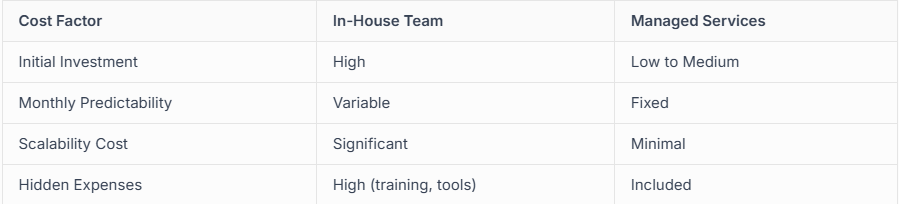
Expertise and Knowledge Breadth
The talent landscape presents significant challenges for in-house recruitment. Salesforce professionals with advanced certifications remain scarce, and competition for skilled administrators intensifies as more organisations adopt the platform.
Managed service providers maintain teams with diverse specialisations across Sales Cloud, Service Cloud, Experience Cloud, and emerging technologies like Agentforce. This breadth proves difficult to replicate internally without substantial investment.
When evaluating strategic decisions for Salesforce implementation, access to specialists who've solved similar challenges across multiple industries provides invaluable perspective. Managed services deliver this cross-pollination of ideas and proven solutions.
Scalability and Resource Flexibility
Business requirements fluctuate throughout the year. Peak periods demand additional support, whilst quieter months may not justify full-time staffing levels.
Managed services accommodate these variations through:
Flexible resource allocation matching the current workload
Rapid scaling for major projects or releases
Access to specialist skills for specific initiatives
Reduced risk during staff absences or departures
In-house teams struggle with these dynamics. Hiring additional permanent staff for temporary peaks creates inefficiency, whilst understaffing during critical periods jeopardises project delivery.
Choosing between managed services and in-house teams requires an honest assessment of your organisation's workload patterns and growth trajectory.

Resource Scaling Comparison
Strategic Focus and Innovation
The Salesforce managed services vs in-house decision significantly impacts your organisation's ability to pursue strategic initiatives. In-house teams frequently become consumed by day-to-day maintenance, user support, and minor configuration changes.
This operational burden limits capacity for transformational projects that drive competitive advantage. Managed services providers typically structure engagements to balance tactical support with strategic development.
Organisations pursuing AI-ready solutions particularly benefit from managed services expertise in emerging technologies. Providers invest heavily in upskilling their teams across new Salesforce releases and capabilities, ensuring clients access cutting-edge functionality without internal training overhead.
Control and Cultural Alignment
In-house teams offer advantages in organisational knowledge and cultural integration. These professionals understand internal politics, business processes, and stakeholder preferences through daily immersion.
Benefits of in-house cultural alignment include:
Immediate availability for urgent requests
Deep understanding of business context
Stronger relationships with end users
Greater control over priorities and roadmap
However, this proximity sometimes creates challenges. In-house administrators may face pressure to implement quick fixes rather than sustainable solutions, and understanding the real cost an objectiveof cutting corners becomes crucial.
Managed service providers bring an objective perspective, often challenging assumptions and recommending best practices based on industry standards rather than internal preferences.
Risk Management and Business Continuity
Staff turnover also presents a significant risk for organisations relying on small in-house teams. When a key Salesforce administrator departs, institutional knowledge disappears, and recruitment processes may take months.
Managed services mitigate this risk through team-based delivery models. Multiple professionals share knowledge of your environment, ensuring continuity regardless of individual staff changes. Documentation standards and knowledge transfer protocols further protect against expertise loss.
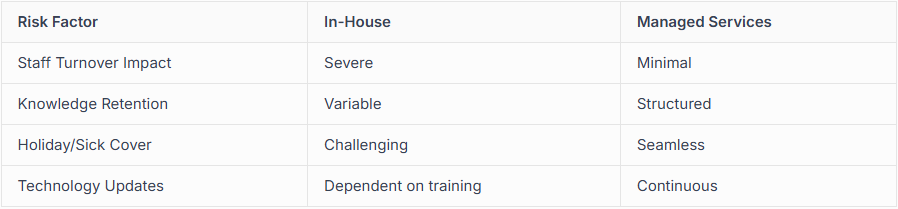
Security and compliance requirements introduce another factor. Managed service providers invest in strong security frameworks, regular audits, and compliance certifications that would be expensive for individual organisations to sustain.

Making the Decision for Your Organisation
The Salesforce managed services vs in-house question lacks a universal answer. Optimal solutions often combine elements of both approaches, particularly for larger enterprises.
Organisations with complex, mission-critical Salesforce environments spanning multiple clouds may justify substantial in-house teams. Those with moderate requirements or limited budgets frequently find managed services deliver superior value.
Consider hybrid models where core in-house capability handles day-to-day user support whilst managed services augment your team and provide strategic development, specialised expertise, and additional capacity for major initiatives. This approach balances control with flexibility whilst managing costs effectively.
Assessment criteria should include current Salesforce complexity, growth projections, budget constraints, internal IT capability, and strategic importance of CRM to competitive positioning. When evaluating Salesforce implementation services, these factors determine whether building internal capacity or partnering externally serves your long-term interests.
The Salesforce managed services vs in-house decision fundamentally shapes how effectively your organisation leverages Salesforce to drive growth and operational excellence. Whether you choose external partnership, internal capability, or a hybrid approach, success depends on aligning your support model with business strategy and resource realities.
capeMBX Consulting helps organisations navigate these decisions through our proven BEACON methodology, delivering clean, scalable implementations that transform Salesforce platforms into sustainable engines for business growth whilst ensuring your team has the support needed for long-term success.
