

Salesforce Field Service Guide: Expert Insights for 2026
Field service management is undergoing a rapid transformation as customer expectations continue to rise. At the forefront of this change, Salesforce Field Service is shaping how businesses deliver efficient, data-driven, and AI-powered service experiences in 2026.
Organisations now face mounting pressure to provide seamless support directly to customers, leveraging the latest digital tools. This guide delivers expert insights, highlights new features, and shares practical strategies to help you unlock the full potential of Salesforce Field Service.
Read on to explore what's new, learn how to optimise scheduling, harness AI advancements, and future-proof your operations for ongoing success.
What Is Salesforce Field Service?
Salesforce Field Service is a powerful solution designed to help organisations manage their mobile workforces and field-based operations with precision. Built as an advanced extension of Service Cloud, it brings together the tools needed for seamless field service delivery. Formerly known as Field Service Lightning, it continues to evolve with each Salesforce release, introducing new features to meet industry demands.
A core strength of Salesforce Field Service is its deep integration with Service Cloud objects like Work Orders and Cases. This enables unified service management, from customer requests to onsite job completion. For a detailed look at how Service Cloud underpins field service operations, see Service Cloud Powers Case Management.
Key components include:
Service Appointments: Schedule and track every field visit.
Dispatcher Console: Assign jobs and monitor technician activity in real time.
Field Service Mobile App: Give technicians access to schedules, customer details, and offline functionality.
Territory Management: Allocate resources across geographic or functional areas for optimal coverage.
For example, cable installation companies use Salesforce Field Service to track technician locations, manage inventory, and ensure appointments are kept on time. The robust data model links appointments, resources, territories, and service contracts, providing visibility across every moving part.
Businesses with complex service operations, especially those coordinating multiple teams and assets, benefit most from Field Service. According to Salesforceben.com, organisations using field service management solutions report up to 30% improvement in workforce productivity.
Who Uses Salesforce Field Service?
Salesforce Field Service is widely adopted by organisations that manage mobile workforces and deliver on-site services. Typical industries include utilities, telecommunications, healthcare, logistics, and high-end retail installation. Companies with complex field operations benefit most, as the platform streamlines job assignment and resource management. For more on industry-specific applications, see Field Service for Energy, Utilities, and Logistics.

Salesforce Field Service supports various personas within an organisation, each interacting with different platform components:
Dispatchers: Use the Dispatcher Console to assign jobs based on skills, availability, and location.
Field Technicians: Operate with the Field Service Mobile App, accessing work orders and real-time updates, even offline.
Service Agents: Initiate cases, escalate to work orders, and coordinate customer communication.
Service Managers: Monitor performance using analytics and dashboards to ensure efficiency.
These roles, when combined, create a streamlined workflow, reducing administrative overhead and enhancing accountability.
Consider a high-end door installation company. Effective coordination between prep teams, delivery crews, and installers is critical. As service complexity and the number of coordinated roles increase, so does the value of Salesforce Field Service. Mobile apps within the platform reduce paperwork by up to 80% and improve first-time fix rates, driving measurable improvements in customer satisfaction.
Essential Salesforce Field Service Terminology
Understanding the language of Salesforce Field Service is key to mastering its capabilities and driving operational excellence. Each term forms the foundation for seamless scheduling, resource allocation, and customer satisfaction.

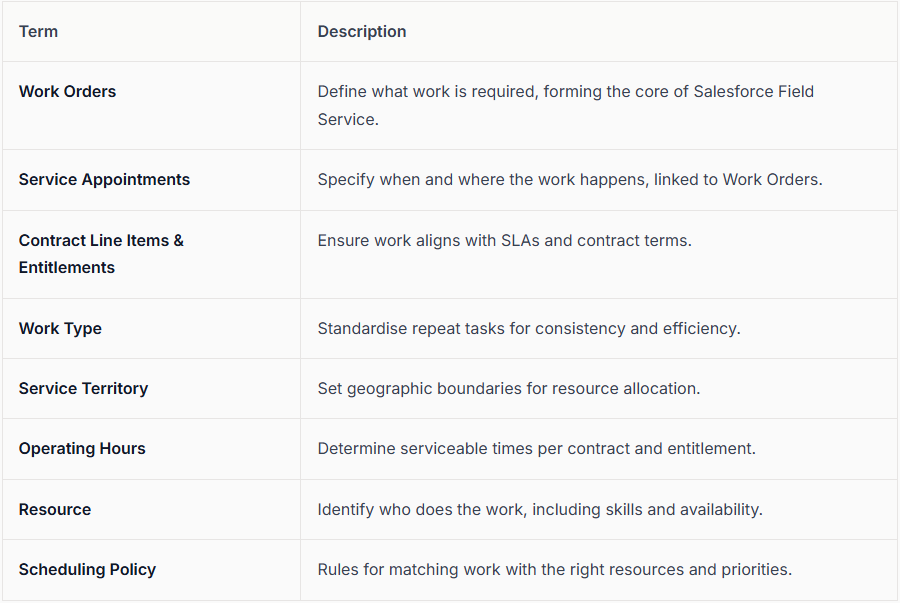
For example, a maintenance company can streamline recurring visits by combining ‘Work Types’ and ‘Scheduling Policies’. This approach enables the platform to automate assignments, track entitlements, and ensure all work aligns with customer agreements. To deepen your understanding of these concepts and support ongoing learning, explore the Salesforce Learning Guide 2026 for practical tips and upskilling resources.
Scheduling and Optimisation in Salesforce Field Service
Efficient scheduling is the backbone of salesforce field service. With the right tools, companies can streamline appointments, reduce travel, and boost customer satisfaction. Modern field service teams rely on advanced scheduling features to achieve operational excellence.

Core Scheduling Features
Salesforce Field Service offers automated appointment booking, matching jobs to the best technician based on skill, location, and availability. Dispatchers gain real-time visibility to track progress and make quick adjustments when needed.
Key features include:
Drag and drop rescheduling for rapid changes
Dynamic route optimisation to reduce travel time
Live status updates for both teams and customers
For example, utility companies have seen increased job completion rates and reduced operational costs by using these intelligent scheduling capabilities.
Optimisation Techniques and AI Integration
AI is transforming how organisations use Field Service for resource allocation and planning. AI-driven recommendations help dispatchers assign the right technician and optimise routes, while predictive analytics can flag potential delays or required parts ahead of time.
Machine learning adapts scheduling policies based on historical data and live updates. According to Salesforce Announces AI-Driven Field Service Innovations, companies leveraging these AI advancements can reduce operational costs by up to 25%.
Best Practices for Effective Scheduling
To maximise results, regularly review and refine scheduling policies to align with business goals. Consider these best practices:
Integrate customer preferences and service level agreements into scheduling
Use geo-mapping and real-time traffic data for adjustments
Monitor key performance indicators such as first-time fix rate and travel time
Continuous improvement and data-driven decisions help ensure field service delivers consistent value.
AI and Future Trends in Salesforce Field Service for 2026
AI is fundamentally reshaping how field service operates, with the next few years set to deliver even greater transformation. Automated job assignments, predictive maintenance, and intelligent workflow suggestions are becoming standard, allowing teams to anticipate customer needs and act before issues escalate. According to Salesforce’s latest projections, 60% of service leaders expect to boost investment in AI-driven field service tools by 2026.
The Salesforce Announces Spring 2026 Product Release highlights new AI-powered features, including dynamic scheduling, real-time resource allocation, and intelligent routing. Integration with Agentforce is also on the rise, combining human expertise with AI agents for faster resolutions and improved service accuracy. Mobile advancements are a key focus, with enhanced offline capabilities, voice command features, and augmented reality tools supporting technicians in the field.
Data-driven insights are empowering organisations to forecast demand, optimise inventory, and proactively engage customers. For example, healthcare providers are leveraging predictive maintenance to minimise equipment downtime and ensure compliance. The adoption of self-service portals and chatbots is accelerating, enabling customers to book appointments and receive updates independently.
To capitalise on these trends, organisations must prioritise AI readiness by preparing their data, processes, and teams for seamless integration. Tools like our AI Readiness Check can help businesses evaluate their preparedness and build a robust foundation for the future of Salesforce Field Service.
Implementing and Maximising Salesforce Field Service Success
A successful implementation requires careful planning, clear objectives, and ongoing support. To achieve maximum return, organisations must focus not only on technical setup but also on change management and continuous improvement.
Implementation Steps and Change Management
Begin by assessing your business needs and mapping existing field service processes. Set measurable goals and KPIs to guide your salesforce field service journey. Customise objects and workflows to reflect real-world requirements, and prioritise comprehensive training for all user groups.
Pilot the solution with a small team to gather feedback and adjust configurations. Monitor adoption and satisfaction to ensure a smooth transition. According to the 2025 Field Service Industry Report, structured rollout and training can result in significant efficiency gains, as seen in manufacturing firms reducing service delivery times by 40%.
Ongoing Optimisation and Support
Continuous improvement is key to unlocking the full value of Salesforce Field Service. Regularly update scheduling policies and resource profiles based on analytics. Leverage the latest Salesforce releases and AI features to stay ahead.
Use dashboards to track KPIs and encourage feedback from field teams. Engaging with partners or consultants can provide advanced integration support. Reviewing processes quarterly can boost customer retention by 20%. Explore future market trends in the Field Service Management System Market Size & Share Trends, 2035 to ensure your strategy remains competitive and forward-thinking.
As we've explored, staying ahead in field service means blending the latest AI advancements with proven strategies for optimising your operations. If you're ready to take the next step and see how expert guidance can accelerate your journey toward efficient, AI-ready service delivery, we’re here to help.
Let's discuss your unique challenges and goals so you can unlock the full potential of Salesforce Field Service with confidence. If you'd like tailored advice or want to see how a clean, scalable implementation could look for your business, simply Book a free consultation call.
