

Salesforce is changing how businesses interact with their CRM, and the shift goes far beyond adding another AI assistant.
For years, getting value from Salesforce meant navigating dashboards, searching records, building reports and moving between different applications. Now, imagine simply asking Salesforce what you need, and having it surface the right information, recommend the next step or complete the task.
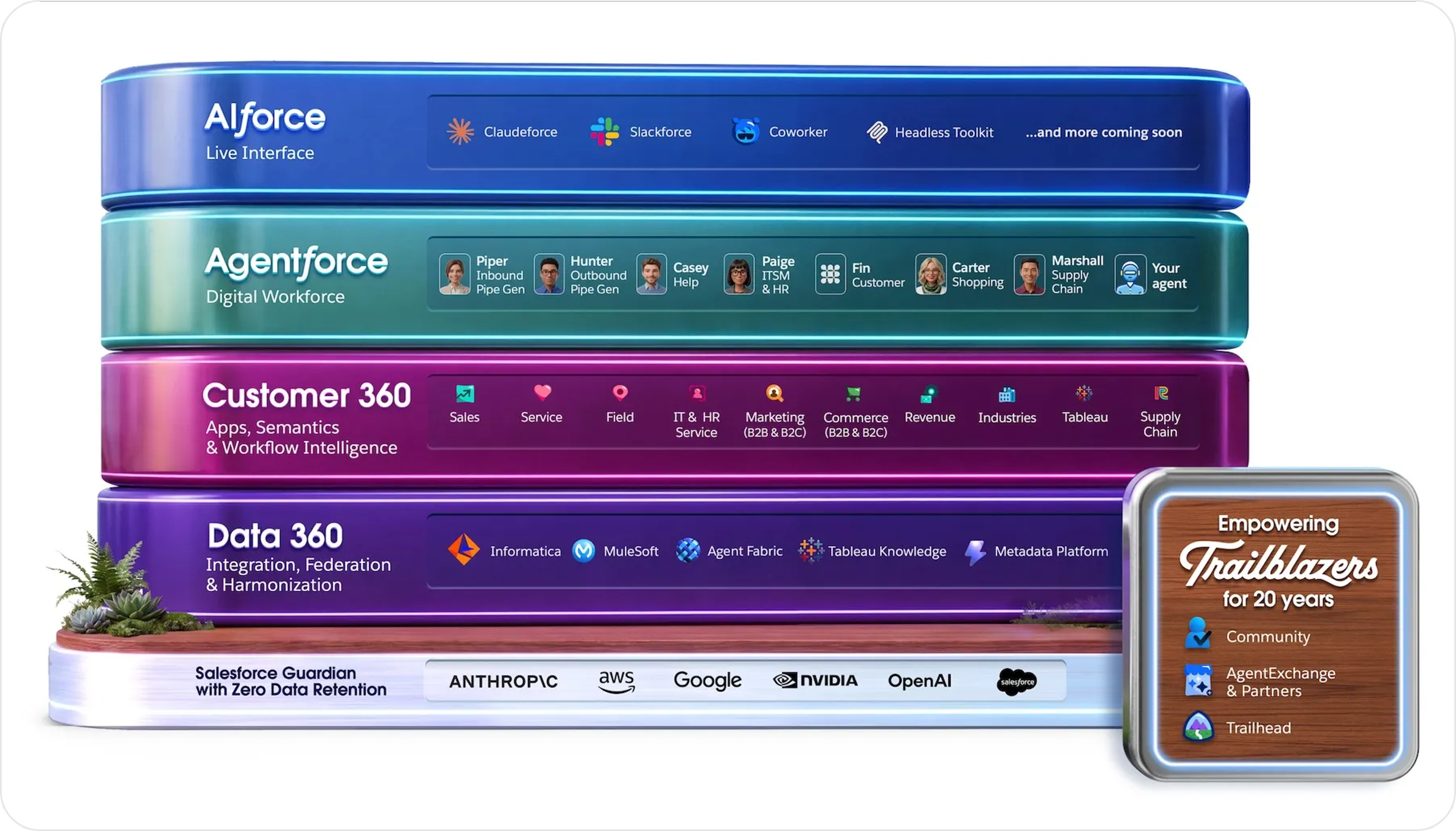
At AIforce World Tour London, on the 15th October, I saw the vision behind AIforce, Salesforce's new conversational and live interface layer, which was previously introduced in September at Dreamforce 2026.
But AIforce is only part of a much bigger picture. Together with Agentforce, Customer 360 and Data 360, Salesforce is building an interconnected architecture designed to bring people, data, applications and AI agents together.
Understanding how these layers work is becoming increasingly important for organisations looking to maximise their Salesforce investment.
What Is AIforce? Salesforce's New Interface Revolution
At its core, AIforce is Salesforce's new live interface layer, enabling users to interact with Salesforce through natural language, AI-powered agents and dynamic interfaces.
Rather than relying entirely on traditional tabs, menus and forms, users can describe what they want to achieve. For example, a sales director might ask: “Show me the opportunities most at risk this quarter, explain why they're slipping and suggest the next actions.”
Instead of manually navigating multiple reports, the user could receive relevant insights, supporting records and suggested actions within a single experience. Importantly, AIforce isn't simply another chatbot.
It introduces the concept of composable live interfaces, where information, workflows and interactive elements can be assembled around the user's immediate needs. AIforce is designed to bring Salesforce capabilities into tools employees already use, including Slack, Claude and Salesforce itself.
This represents a fundamental shift: rather than requiring people to navigate Salesforce, Salesforce can increasingly meet them where they work.
AIforce vs Agentforce: What's the Difference?
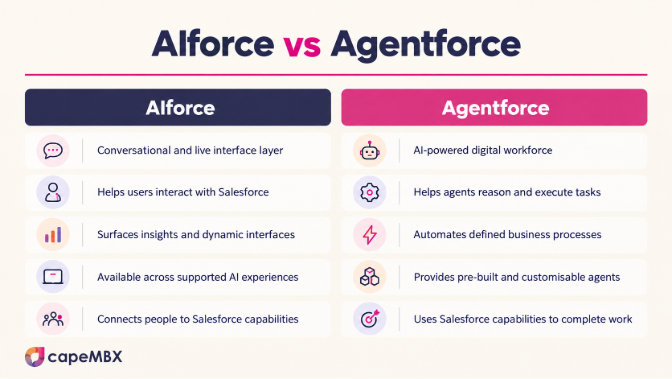
One of the biggest questions following Dreamforce 2026 is how AIforce differs from Agentforce. While both use artificial intelligence, they serve distinct but complementary purposes.
AIforce is how you interact with Salesforce. Agentforce is the AI digital workforce that can carry out work on your behalf. AIforce provides the interface through which users ask questions, explore information and initiate actions. Agentforce provides intelligent agents capable of reasoning, following instructions and executing business processes within defined permissions and guardrails.
For example, a customer service manager might use AIforce to request an overview of unresolved priority cases. Behind the scenes, Agentforce could help analyse the cases, identify emerging issues and execute authorised follow-up workflows.
The distinction matters because businesses don't necessarily have to choose one over the other.
Understanding Salesforce's Four Layers
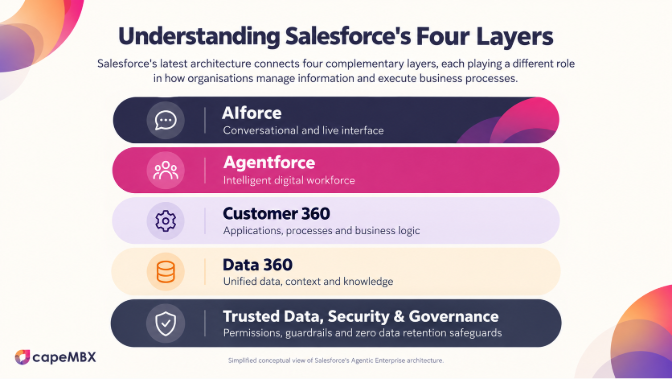
Salesforce's latest architecture connects four complementary layers, each playing a different role in how organisations manage information and execute business processes.
1. Data 360: The Foundation of Trusted AI
At the foundation sits Data 360, Salesforce's unified data and context layer. It brings together customer information, enterprise data, metadata and knowledge from across the organisation, including connected systems. This matters because AI is only as useful as the information it can access and understand.
If customer data is fragmented, outdated or inconsistent, even sophisticated AI agents can produce incomplete or unreliable results. Data 360 helps create a more connected view of the business, enabling AI to operate with relevant customer context.
For organisations dealing with disconnected systems, improving data quality is often the most important first step towards meaningful AI adoption.
2. Customer 360: The Business Logic and Applications Layer
Customer 360 represents Salesforce's established CRM applications, including Sales Cloud, Service Cloud, Marketing Cloud, FSC and Commerce Cloud.
This is where organisations have invested years building customer relationships, automating processes and defining how their businesses operate. Its value extends beyond the information stored within individual records.
Customer 360 also contains the business logic, workflows, metadata, permissions and processes that determine what can happen next. For example, Salesforce automation can route service requests, update opportunities or trigger approval processes.
These existing capabilities become even more valuable when AI agents can access and execute them appropriately.
3. Agentforce: Salesforce's AI Digital Workforce
Agentforce introduces intelligent agents that can perform work across Salesforce applications. Unlike traditional automation, which generally follows predetermined rules, AI agents can interpret requests, evaluate relevant context and select from authorised actions to complete tasks.
Potential applications include:
Customer service agents resolving routine enquiries and escalating complex cases.
Sales agents qualifying leads and supporting pipeline development.
Operational agents coordinating workflows across teams and systems.
Industry-specific agents assisting with regulated or specialist processes.
Agentforce combines configurable agents, pre-built capabilities and extensibility through Salesforce's development tools. For organisations already investing in Service Cloud, this creates opportunities to move beyond simple case routing towards more intelligent, context-aware service delivery.
4. AIforce: Bringing Everything Together
AIforce sits above these capabilities as the interaction layer. It brings the underlying data, applications and AI workforce into more accessible experiences.
Salesforce's initial AIforce offerings include Claudeforce, Slackforce and Agentforce Coworker. Claudeforce brings Salesforce context and governed actions into Claude. Slackforce enables Salesforce-powered experiences within Slack. Agentforce Coworker provides an intelligent assistant within Salesforce's Lightning interface.
The underlying Headless Toolkit also enables developers to build custom interfaces and connect compatible AI tools using APIs, skills and Model Context Protocol (MCP).
The result is greater flexibility in how organisations access and use Salesforce without abandoning their existing investments.
Trusted Data, Security and Zero Data Retention
For organisations considering AI adoption, security and governance remain critical. Salesforce's architecture is underpinned by existing access controls, business permissions and the Einstein Trust Layer. The platform provides safeguards including controlled data access, prompt defences, audit capabilities and protections around interactions with third-party language models.
Zero Data Retention is particularly important. Under Salesforce's applicable arrangements, third-party model providers do not retain submitted business data after inference or use it to train their models.
However, this doesn't mean Salesforce stores no information. Business records, permitted interaction logs and other operational data may still be retained within the platform. Businesses must therefore continue to manage permissions, retention policies and compliance requirements carefully.
Salesforce's Agentic Enterprise trust guidance provides further information on these shared responsibilities.
What Does This Mean for Businesses Using Salesforce?
The biggest opportunity isn't simply introducing more AI. It's making existing Salesforce investments work harder. Consider three scenarios.
Sales: Instead of navigating multiple dashboards, a sales leader asks AIforce, through Claude, which opportunities require attention. Agentforce can support follow-up actions using Customer 360 processes and Data 360 context.
Customer service: A service manager requests an overview of recurring complaints. AIforce presents the findings while Agentforce supports authorised actions across case management workflows.
Financial services: An adviser asks for a summary of client interactions, outstanding tasks and upcoming reviews. Relevant information can be brought together through governed access to Financial Services Cloud.
In each example, the opportunity is to reduce manual effort, improve decision-making and help employees focus on higher-value work.
Preparing Your Salesforce Environment for AIforce and Agentforce
Successful AI adoption requires more than activating new technology.
Organisations should assess five areas:
Data readiness: Are customer records accurate, complete and accessible?
Process maturity: Are business workflows documented, consistent and suitable for automation?
Integration: Can Salesforce access the relevant information across existing systems?
Security and governance: Are permissions, approvals and AI action boundaries clearly defined?
User adoption: Do employees understand how conversational and agent-led workflows will support their roles?
Organisations with significant technical debt, unnecessary customisations or poor data quality may struggle to realise the full benefits. This is why AI readiness and effective discovery should come before large-scale AI deployment.
Frequently Asked Questions
Is AIforce replacing Agentforce?
No. AIforce is Salesforce's conversational and live interface layer, while Agentforce provides intelligent AI agents capable of completing business tasks. They are complementary capabilities.
Will AIforce replace Salesforce Lightning Experience?
Not necessarily. AIforce extends how users interact with Salesforce, including through Lightning, Slack, Claude and supported external interfaces.
Does AIforce require Data 360?
AIforce uses Salesforce's existing platform context. The precise Data 360 dependencies vary by capability and use case. Organisations benefit from well-governed, accessible data regardless of the implementation.
Is Salesforce business data used to train external AI models?
Salesforce's applicable zero data retention arrangements prevent third-party language model providers from retaining submitted business data for training. Organisations should still review the specific configuration and data-handling terms.
How should businesses start with AIforce and Agentforce?
Start with a clearly defined business problem. Evaluate data quality, existing processes, integrations and governance before selecting a focused use case with measurable outcomes.
Turning Salesforce's AI Vision Into Business Value
AIforce represents a significant change in how businesses can engage with Salesforce. But the real opportunity comes from connecting it with Agentforce, Customer 360 and Data 360.
Together, these layers create a foundation for more intuitive interactions, intelligent automation and improved access to business information.
At capeMBX, we help organisations close the gap between Salesforce's capabilities and measurable business outcomes.
Through our consultancy-led approach and BEACON methodology, we help businesses assess their existing environment, prepare their data and processes, and identify where AI can deliver meaningful value.
Because the goal isn't simply to introduce AI into Salesforce. It's to get more value from the Salesforce investment you've already made.
