

Salesforce Fin Explained: The New AI Customer Service Agent and How It Compares with Casey
Salesforce has taken another major step towards autonomous customer service with Fin, its new AI customer agent designed to resolve complex customer experience workflows from beginning to end.
Following Salesforce's acquisition of Fin, formerly Intercom, the technology is becoming part of a broader Agentforce strategy that increasingly gives organisations ready-to-use AI agents for specific jobs across sales, service, commerce and operations.
For customer service teams, the important development is not simply another chatbot.
Fin is designed to understand complex customer requests, access relevant business data, reason through what needs to happen, take actions across systems, and continue working towards a resolution without requiring a human agent to manage every step.
But Salesforce customers may already be now familiar with Casey, Salesforce's Help Agent for customer support.
So where does Fin fit, how does it differ from Casey, and what could the arrival of these increasingly capable AI agents mean for customer service teams?

What is Salesforce Fin?
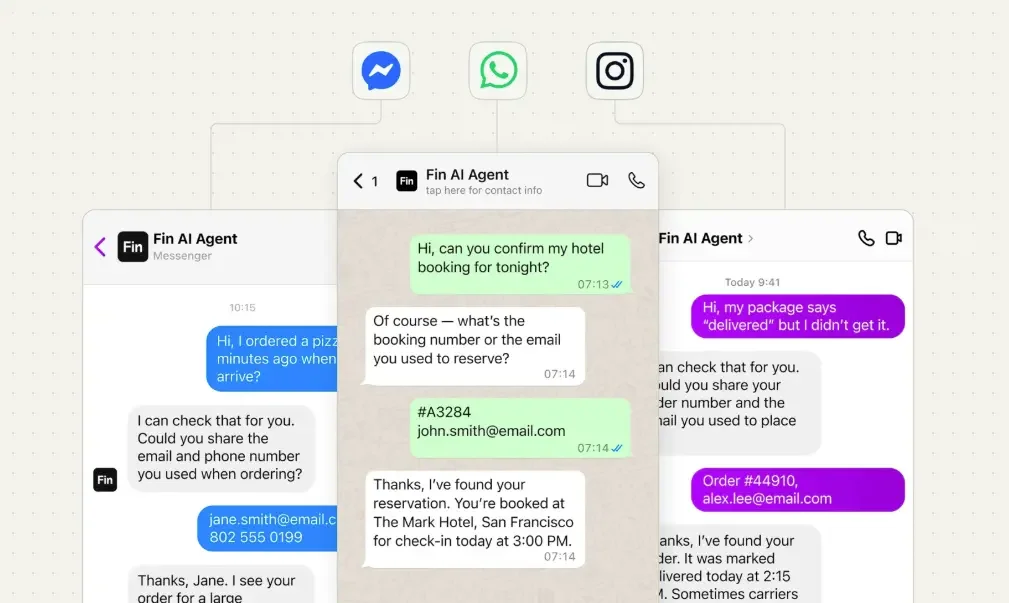
Fin is Salesforce's AI customer agent for handling complex customer experience workflows across multiple channels.
Rather than relying on traditional decision trees or scripted chatbot conversations, Fin uses AI models purpose-built for customer experience to understand what a customer is trying to achieve and determine the steps needed to resolve the issue.
It can operate across channels including live chat, email, WhatsApp, SMS and voice, allowing organisations to provide a more consistent customer experience regardless of where a conversation begins.
This builds on the wider move towards autonomous agents we explored in our guide to Salesforce's new Agentforce agents.
The major difference is that an autonomous agent is not restricted to answering questions.
Depending on the workflow and permissions available to it, an agent can retrieve information, update records, initiate processes, interact with other systems, and determine what action should happen next.
Fin vs Casey: What's the Difference?
This is likely to be one of the biggest questions for existing Salesforce customers. Casey is Salesforce's pre-packaged Help Agent, designed to provide autonomous customer support across voice, SMS, WhatsApp and web channels.
Out of the box, Casey supports use cases including:
Frequently asked questions
Returns
Account management
Order-related enquiries
Appointment scheduling
Case management
Human escalation
Because Casey is deeply integrated with Agentforce and Salesforce data, it can do considerably more than a conventional FAQ chatbot.
Fin, however, is being positioned for more complex customer experience workflows. A useful way to think about the distinction is this:
Casey provides an immediately deployable customer support agent for common and repeatable service requirements. Fin extends autonomous service into more sophisticated, multi-step customer journeys where the agent may need to reason across several systems and actions before reaching a resolution.
The distinction will undoubtedly evolve as Salesforce brings the technologies closer together, but both point towards the same destination: customer service where AI agents increasingly own resolutions rather than simply assisting with individual tasks.
How Does Salesforce Fin Work?
When a customer contacts a business, Fin can analyse the request to determine intent, context and the actions required. Instead of returning a generic response, the agent can draw on customer information, service history, knowledge content and connected systems to decide how the enquiry should be handled.
A typical interaction could involve Fin:
Understanding the customer's request in natural language.
Identifying the customer and retrieving relevant account information.
Reviewing previous cases or interactions.
Accessing appropriate knowledge or policy information.
Taking actions across Salesforce or connected platforms.
Updating the customer record or case.
Continuing the conversation until the issue is resolved.
Escalating to a human employee when judgement or specialist intervention is required.
This is where integration with Salesforce Service Cloud becomes particularly important.
Customer service rarely exists entirely inside one application. A resolution might require information from Salesforce, an order management system, billing platform, knowledge repository or another operational application.
Connecting those systems is what allows an AI agent to move from simply providing answers to actually completing work.
Five Important Use Cases for Fin
1. End-to-End Customer Issue Resolution
Perhaps the most significant Fin use case is resolving customer enquiries without requiring a human agent to complete individual steps.
Consider a customer contacting an organisation because an order has not arrived. Instead of simply showing tracking information, an autonomous agent could potentially identify the order, inspect its status, determine that delivery has failed, check the organisation's replacement policy, initiate the appropriate process, and confirm the outcome with the customer.
The goal becomes resolution rather than response.
2. Intelligent Self-Service and Case Deflection
High-volume service teams spend considerable time dealing with repeatable enquiries. Giving customers access to an autonomous agent 24/7 can allow many of these issues to be resolved before a traditional support ticket needs to reach an employee.
For organisations already using Salesforce case management, this can change the role of the case queue itself. Rather than every enquiry becoming human work, AI agents can manage appropriate requests autonomously while cases requiring investigation, empathy or specialist knowledge are escalated.
3. Cross-System Customer Service Workflows
Some of the most valuable opportunities arise when an agent can work beyond Salesforce. Through APIs and integrations, customer enquiries can trigger actions across CRM, ERP, billing, order management, and other platforms.
For example, resolving a billing problem could require the agent to:
Identify the customer in Salesforce
Retrieve the relevant invoice
Check payment information
Query another financial platform
Update the case
Trigger a follow-up process
Explain the resolution to the customer
This type of orchestration is where Salesforce automation and agentic AI increasingly begin to converge.
4. Intelligent Escalation to Human Teams
Autonomy does not mean removing people from customer service. Some conversations involve complaints, vulnerable customers, unusual circumstances, or decisions requiring human judgement. A well-designed AI service agent should recognise those boundaries.
When escalation is necessary, the customer should not need to start again. The human service representative should receive the conversation history, customer context, actions already completed and relevant information required to continue the interaction.
The objective is therefore not AI or people. It is designing the right relationship between them.
5. Customer Service at Global Scale
Fin can also help organisations provide support across different channels, locations and time zones without requiring service capacity to increase at exactly the same rate as customer demand.
This is particularly relevant for organisations experiencing seasonal volume spikes or expanding into new markets.
AI agents can absorb appropriate service volume while human employees concentrate on the interactions where expertise and judgement deliver the greatest value.

Preparing Salesforce for Fin and Agentforce
Deploying an autonomous agent requires more than enabling technology. The quality of its results is heavily influenced by the quality of the environment surrounding it. Before implementation, organisations should consider four areas in particular.
Data
Customer information needs to be accurate, accessible, and appropriately governed. An AI agent working with incomplete customer information will simply make decisions using incomplete context.
Knowledge
Knowledge articles, policies and product information need to be current and structured clearly enough for the agent to retrieve reliable information. This is why an AI readiness assessment can be valuable before deployment.
Processes
Organisations need to understand how customer issues are actually resolved today. Automating a poorly understood process rarely produces a good customer experience.
Governance
Teams need clearly defined boundaries around what the agent can do autonomously, what requires approval and when a conversation must be escalated. These controls become increasingly important as organisations move from AI that recommends an answer towards AI that can take actions.
Measuring the Business Impact
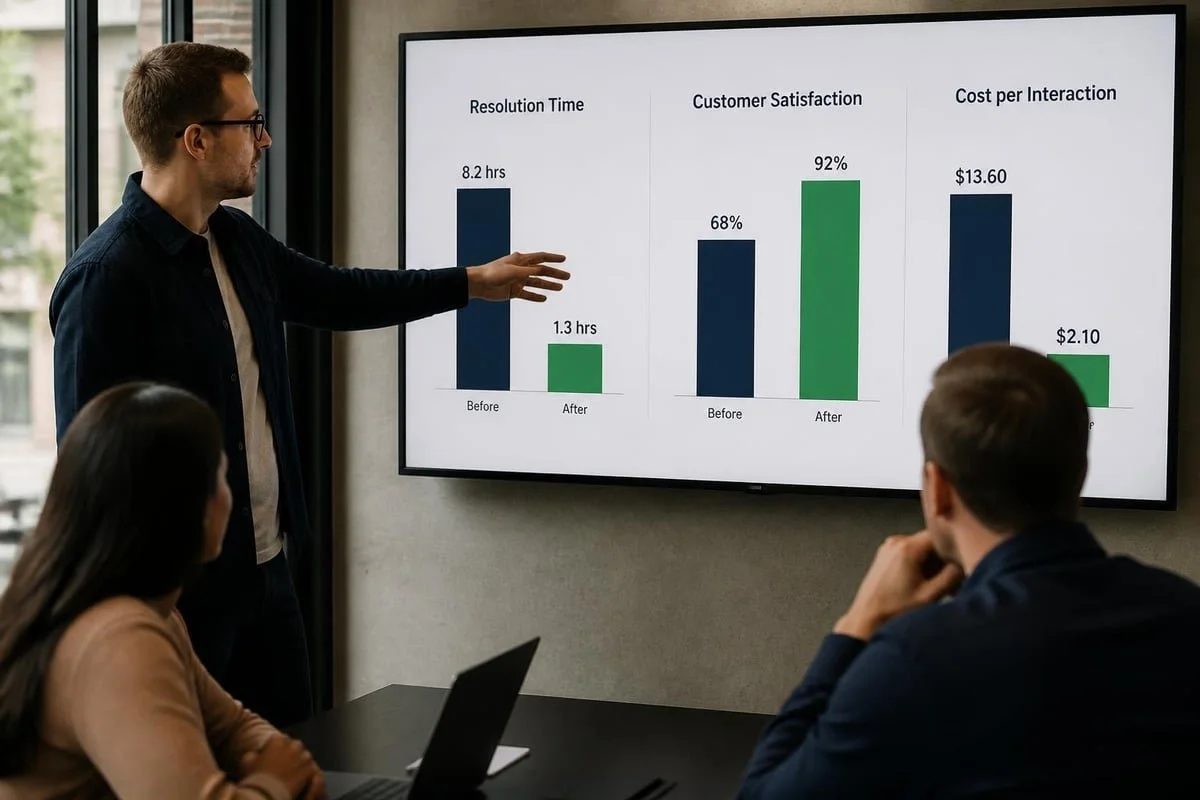
Success should not simply be measured by how many conversations an AI agent handles. Useful customer service metrics include:
Resolution rate
First-contact resolution
Containment rate
Average resolution time
Customer satisfaction
Escalation rate
Cost per resolution
Percentage of interactions requiring human intervention
Salesforce says Fin has demonstrated an average resolution rate of 76%, although individual organisations should establish their own baselines and measure performance against their specific service environment.
Deployment should also be treated as an ongoing programme rather than a one-off implementation. Conversation analysis, knowledge improvements, new agent actions and adjustments to escalation rules can gradually increase the range of customer issues the agent can resolve.
For some organisations, incorporating this into an ongoing Salesforce managed services programme may make more sense than treating AI agents as standalone technology projects.
The Bigger Shift: From Chatbots to Autonomous Service
The most interesting aspect of Fin is not the name of the agent itself. It is what the technology says about where Salesforce believes customer service is heading.
Traditional chatbots were primarily designed to answer questions. The next generation of AI agents is designed to own outcomes. Casey already provides Salesforce customers with a pre-built route into autonomous customer support. Fin pushes the model further towards complex, multi-system customer experience workflows.
For businesses, the question is therefore moving from:
"Can AI answer this customer's question?"
to:
"Can AI actually resolve the customer's problem?"
That is a much more significant transformation.

Frequently Asked Questions
What is Salesforce Fin?
Fin is Salesforce's AI customer agent for resolving complex customer experience workflows. It can understand customer requests, access relevant information and take actions across connected systems to work towards an end-to-end resolution.
What is the difference between Fin and Casey?
Casey is Salesforce's pre-packaged Help Agent, with ready-made capabilities for common customer service requirements such as FAQs, returns, account management and escalation. Fin is positioned towards more complex customer experience workflows requiring deeper reasoning and multi-step resolution.
Is Fin part of Agentforce?
Salesforce has positioned Fin within its new portfolio of job-ready AI agents alongside agents such as Casey, Paige, Carter and others. Fin's technology became part of Salesforce following the acquisition of the company formerly known as Intercom.
Does Fin replace customer service employees?
The more realistic model is augmentation. AI agents can resolve suitable enquiries autonomously while employees concentrate on interactions involving judgement, empathy, investigation or specialist expertise.
Can Fin work with systems outside Salesforce?
Fin's value increases when it can securely interact with the systems required to complete a customer workflow. APIs and integrations can allow AI agents to coordinate activity across Salesforce and external business systems.
How should organisations start with autonomous customer service?
Start with well-understood, repeatable customer journeys where there is good data, reliable knowledge and clear resolution rules. Establish governance and baseline metrics, prove the model, and then expand into increasingly complex workflows.
Getting Your Customer Service Ready for Agentic AI
Fin, Casey and the broader Agentforce platform demonstrate how quickly customer service is moving from conversational AI towards genuine autonomous resolution. But successful adoption will depend far more on data, processes, integration and governance than simply switching on an AI agent.
capeMBX helps organisations assess their Salesforce environment, identify high-value Agentforce opportunities and build the foundations required for AI-enabled customer service. Our approach combines Salesforce expertise with practical process design to ensure autonomous agents are solving the right problems and delivering measurable customer and operational value.
