

Salesforce case management forms the foundation of effective customer service within the Salesforce ecosystem. As businesses increasingly prioritise exceptional customer experiences in 2026, understanding how to leverage this powerful object within Salesforce Service Cloud becomes essential for organisations seeking to streamline support operations, reduce resolution times, and enhance customer satisfaction.
Whether you're implementing Service Cloud for the first time or optimising an existing setup, mastering Salesforce cases can transform your customer service capabilities and deliver measurable competitive advantages.
Understanding the Fundamentals of Salesforce Cases
The Salesforce Case object represents a customer question, feedback, or issue requiring resolution. According to official Salesforce documentation, cases serve as the central repository for tracking customer interactions from initial contact through final resolution.
Cases capture essential information, including:
Customer contact details and account relationships
Issue description and priority level
Assignment information and ownership
Status tracking throughout the lifecycle
Related communications and activities
Each case maintains a complete audit trail, enabling service teams to understand context quickly and respond effectively. This comprehensive tracking ensures no customer enquiry falls through gaps whilst providing valuable insights for continuous improvement.

Case Architecture and Relationships
Cases don't operate in isolation within Salesforce. They connect to Accounts, Contacts, and various other objects, creating a rich tapestry of customer information. This relational structure enables service teams to access complete customer histories, previous interactions, and relevant business context without switching between systems.
The object's flexibility allows organisations to customise fields, page layouts, and record types to match specific business processes. When implementing strategic Salesforce solutions, understanding these architectural relationships proves crucial for success.
Setting Up Salesforce Cases for Success
Proper configuration determines whether Salesforce cases become efficiency engines or administrative burdens. The setup process involves multiple considerations, from basic field customisation to advanced automation rules.
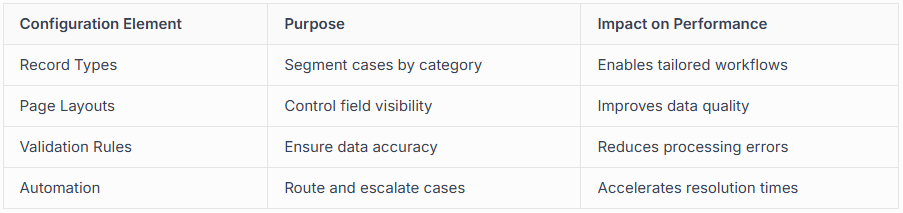
Begin by defining case categories that align with your service delivery model. Different issue types often require distinct handling processes, and Service Cloud configurations should reflect these variations through targeted record types and page layouts.
Customising Fields and Properties
Standard fields provide robust functionality, but custom fields enable precise tracking of business-specific information. Consider what data points your team needs for effective case resolution, then build your schema accordingly.
Essential custom field categories include:
Service level agreement (SLA) tracking
Product or service identifiers
Technical specifications
Resolution codes and root causes
Customer satisfaction metrics
Remember that every additional field increases user complexity. The BEACON methodology emphasises balancing comprehensive tracking with user adoption, ensuring your configuration serves operational needs without overwhelming staff.
Automation and Routing Strategies
Automated case routing transforms customer service efficiency by directing enquiries to appropriate teams without manual intervention. Modern implementations leverage workflow rules, Process Builder, and Flow to create sophisticated routing logic based on case attributes.
The Salesforce customer service workflow blog outlines key automation opportunities, from auto-response emails to escalation processes. Implementing these capabilities requires careful planning to ensure cases reach qualified handlers promptly.

Queue Management and Assignment Rules
Queues organise cases by team, skill set, or product line, enabling efficient workload distribution. Assignment rules then automatically direct incoming cases to designated queues or users based on predefined criteria.
Effective queue structures typically include:
First-tier support queues for initial triage
Specialist queues organised by expertise area
Escalation queues for complex or urgent issues
Regional queues for timezone-specific handling
Best practices for case management emphasise creating clear ownership pathways whilst maintaining flexibility for shifting priorities. This balance prevents cases from languishing unattended whilst accommodating dynamic resource allocation.
Measuring Performance and Continuous Improvement
Salesforce cases generate valuable data for measuring service performance and identifying improvement opportunities. Standard reports track metrics like case volume, resolution times, and customer satisfaction, whilst custom dashboards provide real-time visibility into team performance.
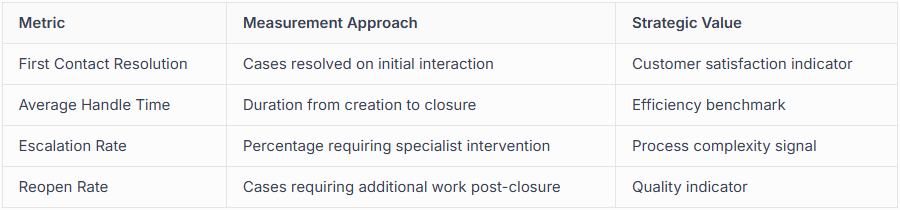
The Service Cloud case management capabilities enable organisations to track these metrics effortlessly, surfacing insights that drive operational excellence.
Implementing Service Level Agreements
Service Level Agreements (SLAs) establish expectations for case handling, creating accountability whilst managing customer expectations. Salesforce supports SLA implementation through milestone tracking, automatically monitoring whether cases meet defined response and resolution timeframes.
Configure escalation actions that trigger when cases approach SLA violations, ensuring management visibility and intervention opportunities. This proactive approach prevents minor issues from becoming customer satisfaction disasters.

Advanced Capabilities for 2026
Modern Salesforce implementations extend beyond basic case management, incorporating artificial intelligence and omnichannel capabilities. Agentforce Service Cloud solutions demonstrate how AI-powered tools can predict case priority, suggest solutions, and even automate routine resolutions.
Integration capabilities connect Salesforce cases to external systems, creating unified customer experiences across touchpoints. Whether linking cases to IoT platforms or embedding case creation in customer portals, these connections eliminate silos and accelerate resolution.
Emerging capabilities transforming case management include:
Predictive case routing based on historical patterns
Automated case categorisation using natural language processing
Intelligent knowledge base recommendations
Proactive case creation from monitoring systems
These advanced features require proper automation foundations and clean data architectures, underscoring the importance of strategic implementation approaches from the outset.
Mastering Salesforce cases requires understanding both technical configuration and strategic service delivery principles. From foundational setup through advanced automation, every implementation decision impacts your team's ability to deliver exceptional customer experiences efficiently.
capeMBX Consulting specialises in transforming Salesforce platforms into robust service engines through clean, scalable implementations that leverage best practices whilst preparing organisations for AI-ready futures. Our BEACON methodology ensures your case management capabilities deliver sustainable competitive advantages aligned with your unique business requirements.
