

Salesforce Education Cloud: What It Is, How It Works and What Institutions Need to Know
Universities and education providers have a data problem. A prospective student's first enquiry might sit in one system. Their application sits in another. Academic records live in the Student Information System (SIS), course activity in the Learning Management System (LMS), support requests somewhere else, and alumni engagement may be managed by another team entirely.
The result is often a fragmented view of the student and a lot of manual work connecting the dots.
Salesforce Education Cloud, now also referred to by Salesforce as Agentforce Education, is designed to bring those experiences together. It combines CRM, education-specific data and workflows, analytics and increasingly AI agents to support the learner journey from first enquiry through to student success and alumni engagement.
But what does Education Cloud actually do, and where does it fit alongside an institution's existing technology?
What Is Salesforce Education Cloud?
Salesforce Education Cloud is Salesforce's purpose-built platform for education.
Rather than taking a standard CRM and asking institutions to build every education process from scratch, Education Cloud provides a specialised education data model alongside functionality for areas including:
Recruitment and admissions
Academic operations
Student success and advising
Student financials
Advancement and alumni relations
AI-powered student and staff experiences
The objective is to create a connected view of each learner and give different departments access to the information and workflows relevant to them.
For example, an advisor could see relevant academic and engagement information alongside previous support interactions rather than searching across multiple disconnected systems.
Is Education Cloud the Same as EDA?
No, and this is an important distinction for institutions researching Salesforce.
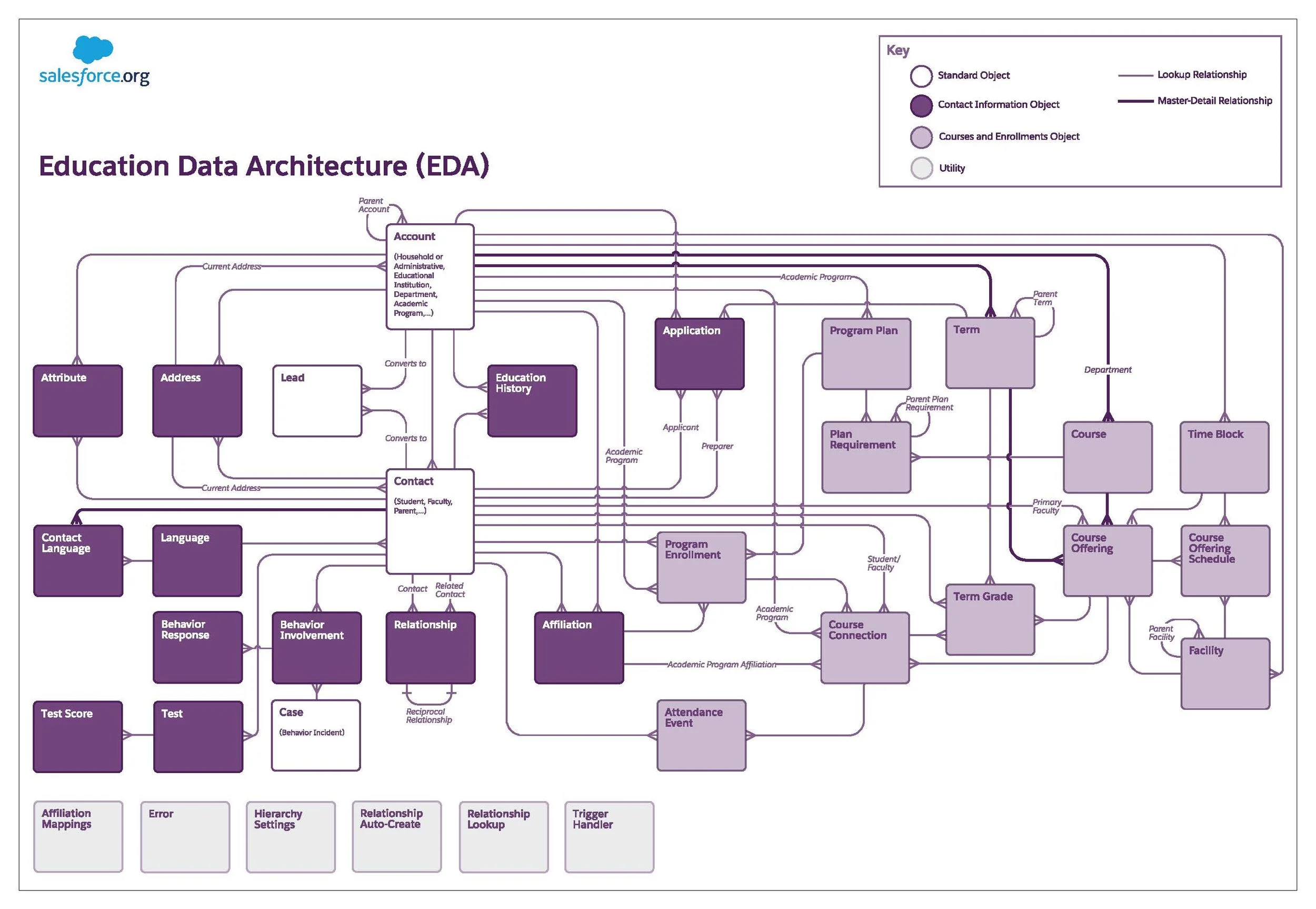
Salesforce's Education Data Architecture (EDA - see image below) is an earlier, community-driven architecture that provides an education-specific data model on Salesforce.
The current Education Cloud does not run on EDA.
Instead, Education Cloud uses its own Education Data Foundation, built directly into the core Salesforce platform. Education-specific concepts such as courses, grades, programmes and learner information can therefore be represented using native Salesforce objects.
Organisations already using EDA do not necessarily need to replace it immediately. However, institutions planning a new Salesforce implementation should understand which architecture they are evaluating and how Salesforce's education roadmap has evolved.
This is also why good architectural planning matters. Decisions made at the beginning of a Salesforce programme can have implications years later. We explore that further in our guide to three strategic decisions for a Salesforce implementation.
Implementation Considerations for Educational Institutions
Deploying Education Cloud requires careful planning to ensure alignment with institutional processes and compliance requirements. The official Salesforce Education Cloud overview outlines various deployment models, yet successful implementations demand strategic thinking beyond standard configurations.
Data migration represents one of the most significant challenges. Legacy student information systems often contain decades of historical data with inconsistent formatting and quality issues. Institutions must prioritise data cleansing and establish governance frameworks before migration begins.
Integration with Institutional Systems
No platform operates in isolation within educational environments. Understanding Salesforce Education Cloud requires acknowledging its role within a broader technology ecosystem that typically includes:
Student Information Systems (SIS) managing academic records
Learning Management Systems (LMS) delivering course content
Financial systems handling billing and aid disbursement
Enterprise Resource Planning (ERP) platforms
Communication tools for messaging and collaboration
Successfully integrating these systems demands careful API management and data synchronisation strategies. Many institutions leverage middleware platforms to orchestrate data flows whilst maintaining system independence. The complexity mirrors challenges organisations face when preparing existing infrastructure for AI-ready solutions.
Compliance and Privacy Requirements
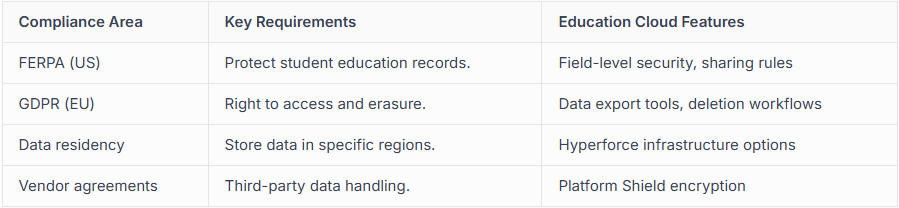
Educational institutions operate under stringent data protection regulations, particularly regarding student information. Understanding Salesforce Education Cloud means recognising that student privacy obligations shape every configuration decision.
Transforming Student Engagement Through Technology
Modern students expect seamless digital experiences comparable to consumer platforms. Understanding Salesforce Education Cloud involves recognising how it facilitates personalised engagement at scale through automation and intelligence. Attracting and enrolling the right students represents a critical success factor for educational institutions. The recruitment and admissions features streamline the entire prospective student journey from initial enquiry through to enrolment.
Recruitment and Admissions Optimisation
Prospective student journeys begin long before enrolment. Education Cloud enables marketing and recruitment teams to:
Track prospect interactions across multiple channels and touchpoints
Score leads based on engagement and fit criteria
Automate nurture campaigns tailored to programme interests
Streamline application review with collaborative workflows
Predict yield rates using historical data and analytics
These capabilities mirror the structured approach that consulting teams employ when optimising Salesforce implementations for complex organisations. The platform integrates seamlessly with marketing automation tools, enabling admissions teams to deliver targeted content that resonates with different student segments. This approach mirrors the sophisticated customer relationship strategies employed in commercial sectors, adapted for the unique requirements of education.
Application Processing and Decision Management
Managing thousands of applications requires robust workflow capabilities and collaborative decision-making tools. Education Cloud centralises application review, enabling admissions committees to evaluate candidates consistently whilst maintaining comprehensive audit trails.
Institutions can configure custom application portals that align with their specific requirements, from undergraduate admissions to postgraduate programmes. Integration capabilities with standardised education APIs ensure smooth data flow between admissions platforms and student information systems.

Student Success and Retention Initiatives
Once students enrol, maintaining engagement and supporting academic progress becomes paramount. The key features of Salesforce Education Cloud dedicated to student success enable proactive intervention and personalised support at scale.
Advising case management provides:
Centralised view of student academic performance, attendance, and engagement metrics
Early alert systems that flag at-risk students based on configurable criteria
Collaborative case resolution involving advisors, faculty, and support services
Mobile-accessible advisor portals for on-the-go student support
Retention also significantly impacts institutional sustainability and student outcomes. Education Cloud provides advisors and support staff with comprehensive visibility into each learner's progress, enabling early intervention when warning signs emerge.
Case management functionality allows institutions to coordinate support services across academic advising, mental health resources, financial aid, and career services. Recent developments in AI capabilities for higher education platforms enhance these capabilities with predictive analytics and intelligent recommendations.

Advancement and Alumni Engagement
Educational institutions increasingly rely on advancement teams to build lasting relationships with alumni and donors. The key features of Salesforce Education Cloud for advancement operations transform how institutions cultivate these critical relationships.
Constituent Relationship Management
Advancement teams require comprehensive views of alumni engagement history, giving patterns, volunteer activities, and personal milestones. Education Cloud consolidates this information, enabling development officers to personalise outreach and identify major gift prospects.
Campaign management: Track fundraising initiatives across annual giving, capital campaigns, and planned giving
Event management: Coordinate alumni events, reunions, and donor cultivation activities
Volunteer tracking: Manage alumni volunteers, mentors, and advisory board members
Gift processing integration: Connect with financial systems for real-time donation tracking
These capabilities support the sophisticated engagement strategies detailed in higher education technology research, which highlights the strategic importance of unified CRM platforms in advancement operations.
Where Does Agentforce Fit into Education Cloud?
This is becoming one of the most significant areas of Salesforce's education strategy. Salesforce is increasingly positioning Education Cloud around agentic AI, with purpose-built Agentforce capabilities designed for education.
Instead of simply presenting information to staff, AI agents can help answer questions, guide users/students through processes and take permitted actions using institutional data and Salesforce workflows. A prospective student, for example, could ask questions about available courses or the application process without waiting for a staff member to become available. For existing students, an agent could help surface relevant information or guide them towards appropriate services, with escalation to a human where required.
This is where the quality of the underlying Salesforce environment becomes critical. AI connected to incomplete, duplicated or poorly governed information does not solve the data problem. It can expose it.
Institutions considering Agentforce should therefore assess data quality, integrations, permissions, knowledge content and governance before moving into production. Our AI Readiness Check is designed around exactly these questions.
What Does Agentforce Look Like in Practice?
This is already moving beyond theory. capeMBX recently worked with a higher education provider to bring an Agentforce-powered student support agent into production.
The agent uses a knowledge base of approximately 120+ articles to help students with common queries, including course information, exam results and general institutional information. When a query requires additional support, the conversation can be escalated to a human.
The solution also provides visibility into how knowledge content is being used, while governance controls help manage AI consumption and provide safeguards around usage.
It is a practical example of what AI in education can look like: not replacing student services teams, but giving students faster access to information while allowing staff to focus on conversations that genuinely require human support.
For institutions considering Agentforce, the important question is not simply "Where can we use AI?" It is "Which student journeys can we improve safely and measurably?"
Strategic Value and Return on Investment
Quantifying the business case for Education Cloud requires examining both direct cost savings and strategic benefits. Research on Salesforce platform economics provides frameworks for calculating total economic impact across implementation, operation, and value realisation phases.
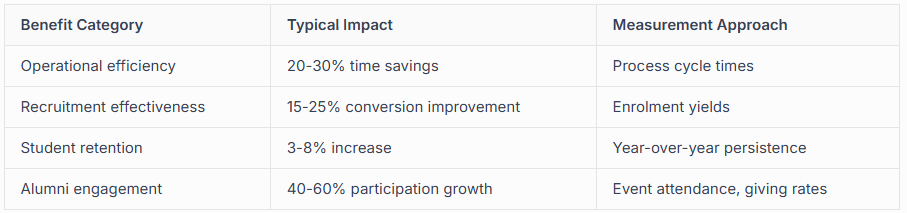
These outcomes emerge from sustained commitment to user adoption and continuous improvement. Understanding Salesforce Education Cloud means recognising that technology alone cannot deliver transformation; institutional change management determines ultimate success. Plus, regular release management processes help institutions adopt new Salesforce features thoughtfully rather than reactively. The platform's three annual releases introduce enhancements that can improve user experience and unlock new capabilities when properly evaluated and deployed.
Frequently Asked Questions
What makes Education Cloud different from standard Salesforce?
Education Cloud includes the Education Data Architecture (EDA), pre-built objects for academic structures like courses and programme enrollments, and industry-specific features for student lifecycle management that aren't available in standard Sales or Service Cloud.
What size institution is Education Cloud designed for?
Education Cloud scales from small colleges to large university systems, with successful deployments ranging from institutions with hundreds of students to those serving hundreds of thousands across multiple campuses.
How long does a typical Education Cloud implementation take?
Implementation timelines vary from 3-6 months for focused deployments to 12-18 months for comprehensive, multi-department rollouts. Timeline depends on scope, data migration complexity, integration requirements, and change management needs.
Can Education Cloud integrate with our existing student information system?
Yes, Education Cloud integrates with major SIS platforms through APIs and middleware solutions. The platform typically serves as the engagement layer whilst the SIS remains the system of record for academic transcripts and degree requirements.
How does Education Cloud support compliance with educational data regulations?
The platform includes configurable security controls, audit trails, and data governance frameworks that help institutions comply with GDPR and GDPR, and other educational data protection requirements.
Understanding Salesforce Education Cloud empowers institutions to deliver the personalised, data-driven experiences that modern learners expect whilst streamlining administrative operations. The key features of Salesforce Education Cloud deliver comprehensive capabilities that transform how institutions manage the complete student lifecycle, from recruitment through alumni engagement. Success requires strategic planning, clean implementation, and ongoing commitment to user adoption and platform evolution.
capeMBX partners with educational organisations to design and deploy Education Cloud solutions that avoid common pitfalls, leveraging the proven BEACON methodology to ensure your investment delivers sustainable value from day one.
