

Claudeforce Explained: What Salesforce in Claude Actually Means for Your Business
The announcement of Claudeforce marks a pivotal moment in enterprise CRM evolution. This groundbreaking partnership between Salesforce and Anthropic introduces a fundamentally different approach to how businesses interact with their customer data. Salesforce has never put another company's name after "force" before. On 26 August 2026, timed to land alongside its Q2 FY27 earnings call, it did exactly that.
What is Claudeforce
Claudeforce represents more than a simple integration between two technology platforms. According to Forrester's industry analysis, this partnership creates an AI interface that Salesforce never built itself. The combination of Claude's advanced reasoning capabilities with Salesforce's comprehensive data platform delivers an intelligent layer that understands context, interprets complex business scenarios, and executes actions with precision.
The platform leverages Anthropic's Constitutional AI approach, which ensures that AI agents operate within defined ethical and operational boundaries. This matters enormously for enterprises handling sensitive customer data across financial services, healthcare, and regulated industries.
And, just to be clear, Claudeforce isn't a single feature. It's two platforms agreeing to run through each other: Claude gets access to Salesforce's data, workflows, and business rules, and Salesforce gets Claude's reasoning built into its own products, including Agentforce and Slack.
The first thing anyone can actually use is Salesforce in Claude, a plugin built for sellers. That's the part worth understanding properly, because it's the part that changes how a sales team's day actually works.
It is important to distinguish Claudeforce from Salesforce in Claude.
Claudeforce - The wider strategic partnership between Salesforce and Anthropic
Salesforce in Claude - The first product from that partnership, bringing Salesforce capabilities directly into Claude
Agentforce - Salesforce's platform for building and deploying AI agents, which can use Claude as a reasoning model
AIforce / Headless 360 - Salesforce technology that makes data, workflows, business logic and actions accessible to AI interfaces

What Salesforce in Claude Actually Does
The Salesforce connector for Claude represents a significant shift in how teams interact with their CRM data. Rather than navigating complex menu structures or writing SOQL queries, users can now ask natural language questions and receive intelligent responses drawn directly from their Salesforce environment.
This integration emerged from Anthropic's partnership with Salesforce, which aims to embed AI capabilities throughout the CRM platform. The Salesforce in Claude connector allows authorised users to query records, analyse trends, draft communications, and generate insights using conversational prompts.
Salesforce in Claude ships with 37 prebuilt sales skills: meeting prep, deal health reviews, pipeline updates, and more. A seller can ask Claude about a deal, get a summary pulled from live CRM data, update a record, and take an approved next action, all without opening a Salesforce tab.
Underneath, this runs on something Salesforce calls AIforce, an enterprise harness that exposes Salesforce data, workflows, and business logic to AI agents through MCP servers, APIs, and CLI tools, rather than a custom integration project. That last part matters. For years, the only way to reach that data was to log in and click through screens. AIforce is Salesforce betting that headless access, reachable by any AI agent, is where the value moves next.
It's currently with pilot customers. Salesforce has said open beta is expected in September 2026, with skills for Service, Marketing, and Commerce planned later in the year.

How the Governance Actually Works
This is the part that determines whether Claudeforce is genuinely useful or genuinely risky, and it's the part most coverage skips past.
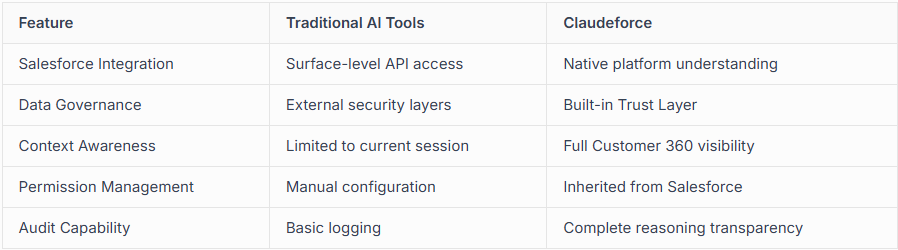
Salesforce in Claude runs through your existing Salesforce permissions and business rules. Claude sees only what the signed-in user is already authorised to see and can only take actions that the user is already authorised to take. An admin sets up authentication once, centrally, rather than configuring it person by person. Write actions come with configurable controls, so an organisation decides where human approval is required and where it isn't.
Patrick Stokes, Salesforce's president of applications and marketing, told CIO that the shift from clicking through Salesforce to reasoning over it through an agent increases how much people actually use the platform, not less. We'd put it more plainly: the permission model was already doing the hard work. Claudeforce just gave it a faster front door.
That's the same logic behind good case management: the rules and routing behind a support queue matter more than the interface an agent uses to work through it. Get the governance right first, and the AI layer on top does what it's supposed to.
Technical Architecture and Enterprise Controls
The official Salesforce product page for Claudeforce outlines several core technical capabilities:
Native Salesforce integration through existing APIs and data models
Contextual awareness across Customer 360 touchpoints
Enterprise Frontier Safeguards for permission management and data security
Agentic workflows that complete multi-step processes autonomously
Transparent reasoning with audit trails for compliance requirements
What distinguishes Claudeforce from generic AI tools is its deep understanding of Salesforce metadata and business logic. The system comprehends relationships between accounts, contacts, opportunities, and cases without requiring extensive prompt engineering. This native awareness enables AI-ready solutions that integrate seamlessly with existing implementations.
Claude Inside Salesforce, and Inside Slack Too
The partnership runs in both directions. Inside Salesforce, Claude now serves as a reasoning model for the Atlas Reasoning Engine, powers Agentforce Vibes and Agentforce Coworker by default, and is selectable inside Agent Builder. For regulated industries, financial services and healthcare especially, Claude is available within the Salesforce Trust Boundary through Amazon Bedrock, which keeps data inside Salesforce's existing security perimeter rather than moving it out.
Slack gets the same treatment: Claude becomes the default model, powers Slackbot, and sits behind Claude Tag for team conversations.
None of this replaces Agentforce. It sits alongside it - more on this below. Claudeforce is Salesforce betting that businesses want an AI interface to reach the data and workflows they already have, rather than rebuild them somewhere else.
Business Applications Across Teams/Industries
Financial services organisations implementing Salesforce in highly regulated environments stand to benefit from the Claudeforce partnership specifically because of how the governance is built. Salesforce in Claude runs on AIforce, Salesforce's agent harness, which means no Salesforce data retention inside Claude and no model training on it, complete with audit trails included. For regulated sectors, Claude can also run inside the Salesforce Trust Boundary via Amazon Bedrock, keeping sensitive data within Salesforce's existing security perimeter.
Salesforce in Claude: What It Actually Does for Sales Teams
This is where Claudeforce stops being an abstract partnership and becomes something B2B sales teams use every day. Salesforce in Claude ships with 37 prebuilt sales skills, and it's this plugin, not Claudeforce generally, that changes how reps engage with prospects and customers. Rather than manually searching through opportunity records, past communications, and product catalogues, sales professionals ask natural language questions and get contextualised answers back.
Salesforce in Claude can:
Prepare reps for meetings using account history and past communications
Flag deal health issues and stalled or inconsistent pipeline stages
Draft personalised outreach incorporating account history and preferences
Update pipeline records conversationally instead of through manual data entry
Automate routine administrative tasks whilst escalating complex decisions
TechTarget's coverage of the launch notes this builds on existing Salesforce AI investment rather than replacing it. Organisations already running Einstein or Agentforce will find Salesforce in Claude augments those tools rather than disrupting them.
Service Excellence and Case Management: What's Coming Next
Service Cloud capabilities aren't part of Salesforce in Claude yet. Salesforce has said a Service-focused skill set is planned for later in 2026 under the same Claudeforce partnership. As explored in our comprehensive guide to Salesforce Cases, traditional case management already asks agents to navigate multiple systems, consult knowledge bases, and apply business rules manually, exactly the kind of work Claude is well placed to help with once that skill set ships.
Expect it to bring:
Automatic routing to the most appropriate agent based on skills, workload, and resolution history
Suggested resolution strategies drawn from past cases and knowledge articles
Drafted customer communications that stay in brand voice and reference case specifics
Trend detection across cases that might point to a systemic issue
Agentforce vs. Claudeforce: What's the Difference?
Given they share the "force" naming and both put Claude to work, it's worth being direct about how they differ.
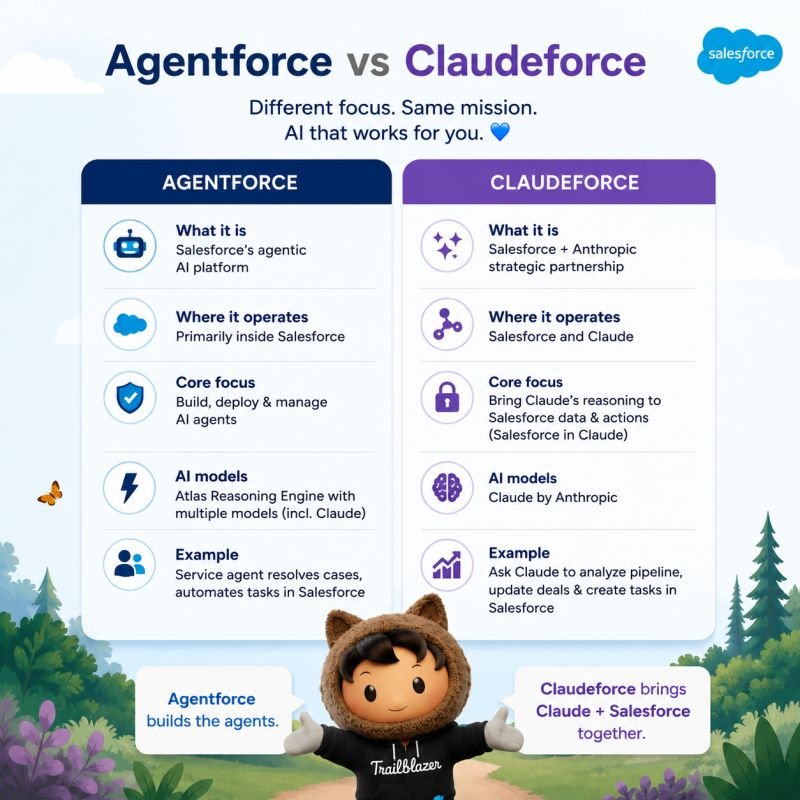
Agentforce is Salesforce's own agentic AI platform, for building, deploying, and managing AI agents that live and act inside Salesforce. It runs on the Atlas Reasoning Engine, which can call on several models, Claude among them, and its agents work autonomously within the platform itself.
Claudeforce isn't a competing platform, it's the partnership. It's what makes Claude one of the reasoning options available inside Agentforce, and it's also what lets someone reach into Salesforce from inside Claude through Salesforce in Claude. The two work in opposite directions: Agentforce brings AI agents into Salesforce, Claudeforce brings Salesforce into Claude, and puts Claude's reasoning inside Salesforce at the same time.
Put simply: Agentforce builds the agents that run inside Salesforce. Claudeforce is what brings Claude and Salesforce together, in both directions, so the reasoning shows up wherever the work already happens.
Is Your Salesforce Data Actually Ready for This?
Here's where we'll give you our honest opinion rather than the launch-week version.
Salesforce in Claude is only as good as the data and structure underneath it. If your opportunity records are half-filled, your permission sets are years out of date, or nobody owns which fields actually mean something, pointing an AI agent at that disorganised data doesn't fix it. It just executes bad decisions faster, with an audit trail attached.
We see this constantly across the financial services, energy, manufacturing, and hospitality clients we work with. The businesses getting real value from Agentforce today are the ones that did the unglamorous work first: clean data, clear field ownership, and a permission model that reflects who should actually see what. That's the whole logic behind our BEACON methodology, and it's why we run an AI readiness check before recommending anyone touch a new agentic feature.
Claudeforce doesn't change that advice. It raises the stakes on it.
What Irish and UK Sales Teams Should Do Now
You don't need to move today. Salesforce in Claude is still in pilot, with open beta expected in September 2026. But there's real preparation worth doing before it lands on your team's desk.
Audit who actually has access to what in your current permission sets, before an agent starts acting on their behalf. Fix the data hygiene issues you've been putting off, because duplicate accounts and stale opportunity stages will surface faster once an AI agent is reading them live. Decide, in advance, which actions need human sign-off and which don't. And talk to whoever runs your Salesforce support model about who owns this once it's live, because "the AI did it" is not an incident response plan.
Most Salesforce implementations underdeliver because nobody owns value realisation after go-live. Claudeforce won't change that pattern on its own. The teams who prepared their platform properly, as mentioned above, will get real value from it fast. The teams who didn't will only surface that chaos and confusion faster.
FAQ
What is Claudeforce? Claudeforce is the expanded partnership between Salesforce and Anthropic, announced 26 August 2026. It brings Claude's reasoning into Salesforce products like Agentforce and Slack, and brings Salesforce data into Claude through a plugin called Salesforce in Claude.
Is Salesforce in Claude available now? It's currently available to select pilot customers. Salesforce has said open beta is expected in September 2026, with additional skills for Service, Marketing, and Commerce planned later in the year.
Does Claudeforce replace Agentforce or Einstein? No. Claude now works alongside Agentforce as a reasoning model and sits behind features like Agentforce Vibes and Agentforce Coworker. It complements existing Salesforce AI investments rather than replacing them.
How is customer data protected? Salesforce in Claude runs through your organisation's existing Salesforce permissions and business rules. Claude can only see and act on what the signed-in user is already authorised to access. Regulated industries can run Claude within the Salesforce Trust Boundary via Amazon Bedrock.
What should we do before Claudeforce reaches our team? Get your Salesforce data and permission sets in order first. An AI readiness check is the fastest way to find out where your platform stands before an AI agent starts acting on it.
Claudeforce, and Salesforce in Claude specifically, mark a real shift in how businesses can put CRM data to work. Getting there takes clean architecture and sound governance, not just the technology. capeMBX helps organisations prepare their Salesforce platform for this, using our BEACON methodology to deliver lasting results.
