

Salesforce Claims Management: How Insurers Can Transform Claims Processing
Insurance claims processing has traditionally been a complex, labour-intensive operation fraught with data silos, manual handoffs, and customer frustration. Modern insurers are turning to Salesforce for claims management to transform these processes into streamlined, intelligent workflows that enhance both operational efficiency and customer satisfaction.
What Is Salesforce Claims Management?
Claims Management sits within Digital Insurance, which is available with Financial Services Cloud Enterprise and Unlimited Editions and Health Cloud. By leveraging Salesforce Claims Management within Digital Insurance, insurers can manage the claims lifecycle on a unified platform that connects policy data, customer information and claims operations.
The Business Case for Salesforce Claims Management
In many cases, large insurance carriers face mounting pressure to reduce claims settlement times whilst controlling operational costs. As a result, these large insurance companies often outsource claims management processes to reduce operational costs, speed up claim handling times, and scale operations efficiently. Traditional legacy systems often force adjusters to navigate multiple screens, manually verify coverage, and chase down information across disconnected databases. These inefficiencies translate directly into higher costs per claim and frustrated policyholders waiting for resolution.
Salesforce addresses these challenges through its Digital Insurance Claims Management solution, which provides a 360-degree view of each claim alongside related policies, customers, and financial transactions. Early adopters report significant improvements in key metrics, including faster settlement times and reduced administrative overhead.
Key Capabilities That Drive Results
The platform's architecture is specifically designed around the complete claims lifecycle, from First Notice of Loss (FNOL) through final settlement. This comprehensive approach ensures no step falls through the cracks.
Core functionality includes:
Automated FNOL intake through multiple channels (web, mobile, phone, partner portals)
Real-time coverage verification against active policies
Intelligent routing to appropriate adjusters based on claim type, severity, and workload
Configurable workflows for investigation, documentation, and approval processes
Financial controls including reserve management and payment authorisation
Integrated communication tools for claimants, adjusters, and third parties

These capabilities work in concert to eliminate the manual work that traditionally consumes adjuster time. When managing claims in Salesforce, teams benefit from pre-configured adjuster workbenches that surface relevant information exactly when needed, reducing the cognitive load on claims professionals.
Implementation Architecture and Integration
Successful Salesforce claims management deployments require thoughtful architecture that balances out-of-the-box functionality with specific organisational requirements. The platform builds upon standard Salesforce objects whilst introducing specialised entities for claims, policy products, and financial transactions.
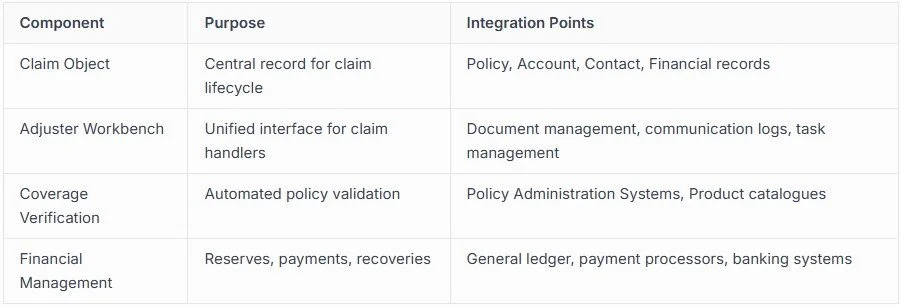
The platform's comprehensive API suite enables seamless integration with existing policy administration systems, document management platforms, and third-party data providers. This connectivity is essential for maintaining data accuracy across the insurance technology ecosystem.
Similar to how Salesforce Cases provide structured case management, the claims module extends these principles with insurance-specific workflows and data models. Understanding this relationship helps teams leverage existing Salesforce knowledge whilst adapting to claims-specific requirements.
Using AI to Improve Claims Adjuster Productivity
The integration of artificial intelligence represents a significant advancement in claims handling efficiency. Salesforce's embedded AI capabilities for claims enable adjusters to process complex claims faster by automatically summarising information across related entities, identifying patterns, and surfacing relevant historical data.
AI-powered features include:
Automated data extraction from unstructured documents (medical reports, repair estimates, police reports)
Predictive reserve recommendations based on historical claim patterns and current claim attributes
Fraud detection algorithms that flag suspicious patterns for investigation
Next-best-action recommendations guiding adjusters through optimal workflows
Sentiment analysis of customer communications to identify escalation risks
These capabilities don't replace human judgement; rather, they augment adjuster expertise by handling routine analysis and freeing professionals to focus on complex decision-making. Much like how Agentforce transforms service operations, AI in claims management elevates the role of claims professionals.

Automating Claims Workflows and Regulatory Compliance
Insurance claims processing operates within a complex regulatory environment that varies by jurisdiction, product line, and claim type. Salesforce claims management provides flexible workflow tools that enforce compliance requirements whilst maintaining operational efficiency.
The Claims Management configuration options allow administrators to define approval hierarchies, enforce time-to-settlement requirements, and maintain audit trails for regulatory reporting. This configuration flexibility is particularly valuable for carriers operating across multiple jurisdictions.
Structured Approval Processes
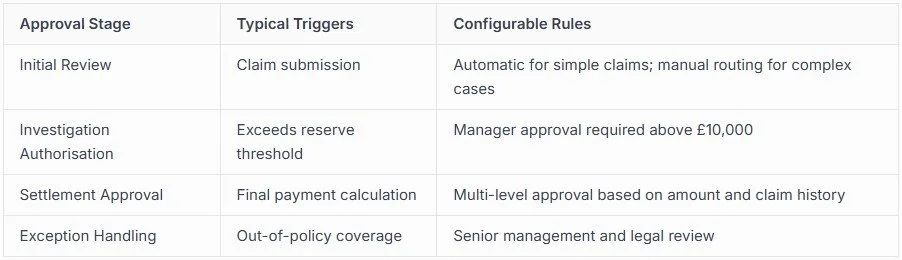
These workflows integrate naturally with broader Salesforce automation capabilities, enabling organisations to build sophisticated business logic without custom code. For insurers already using Financial Services Cloud for general insurance, claims workflows extend familiar patterns into this specialised domain.
Managing External Partners and Claims Stakeholders
Modern insurance claims handling frequently involves external parties: repair shops, medical providers, legal representatives, and independent adjusters. Salesforce enables this collaboration through Experience Cloud portals that provide secure, role-based access to claim information.
When implementing Experience Cloud for insurance partners, organisations can extend their claims processes to external stakeholders whilst maintaining data security and control. Partners receive real-time updates, can submit documentation, and track claim progress without requiring full Salesforce licenses.

This collaborative approach reduces phone calls, eliminates email attachments, and ensures all parties work from a single source of truth. The result is faster insurance claim resolutions and improved stakeholder satisfaction.
Benefits of Salesforce Claims Management
Why would an insurer actually invest in this?
Benefits of Salesforce Claims Management
Reduce manual claims administration
Shorten claim cycle times
Give adjusters a unified view of claims and policy data
Automate repetitive workflows and approvals
Improve policyholder communication
Strengthen financial controls
Connect internal teams and external claims partners
Introduce AI and Agentforce into claims operations
Salesforce Claims Management FAQs
What is Salesforce Claims Management? Salesforce Claims Management is a purpose-built solution within Financial Services Cloud that handles the complete insurance claims lifecycle, from First Notice of Loss through settlement and closure, on a unified platform.
How does Salesforce integrate with existing policy administration systems? Salesforce provides comprehensive APIs that connect claims data with policy administration platforms, enabling real-time coverage verification, policy lookups, and data synchronisation across systems.
Can Salesforce handle complex multi-party claims? Yes, the platform supports sophisticated participant management, allowing you to track and coordinate multiple parties including claimants, beneficiaries, legal representatives, service providers, and adjusters within a single claim record.
What types of insurance claims can Salesforce manage? Salesforce supports various claim types including property, casualty, motor, life, health, and commercial lines, with configurable workflows tailored to each product's specific requirements.
How long does it take to implement Salesforce for claims management? Implementation timelines vary based on complexity, but structured methodologies can deliver core functionality within 12-16 weeks, with phased rollouts for advanced features and integrations.
Considering Salesforce for claims management?
Whether you're replacing a legacy claims platform, integrating Salesforce with existing policy systems or exploring AI-enabled claims processing, capeMBX can help you define the right architecture and implementation roadmap. Implementing Salesforce for claims management requires strategic planning, technical expertise, and deep understanding of both insurance operations and platform capabilities.
capeMBX brings proven expertise in Financial Services Cloud implementations, leveraging the BEACON methodology to ensure your claims transformation delivers sustainable value from day one. Ready to modernise your claims operations?
