

Agentforce World Tour London 2026: Our Honest Recap
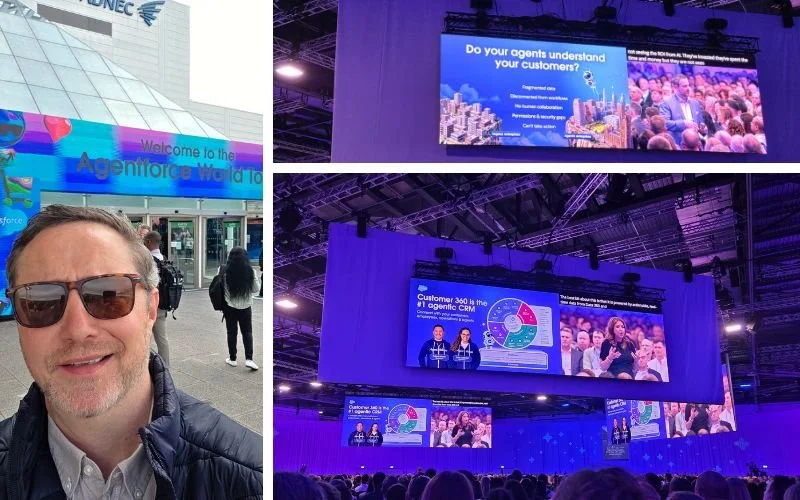
Last Thursday, 18th June, the capeMBX team joined over ten thousand people at ExCeL London for Agentforce World Tour.
This time last year, we were there as a brand-new business. A handful of clients, a lot of energy, and a lot of cold conversations with Salesforce AEs across UKI that we were doing our best to get off the ground. The honest version? We were still finding our feet.
Twelve months on, it felt different. We had clients on the ground at the event with us. A full day of meetings with Salesforce. And for the first time, a genuine sense that what we have been building is getting real traction. That context matters because it shapes how we saw the day. We were not there as mere spectators. We were there as a real partner with skin in the game.
Here is our honest take on what happened, what it means, and the one demo that has changed how we talk to clients about their Salesforce roadmap.
The framing: Agentic Enterprise
The day was built around a single idea. AI agents are starting to do real work alongside your people, and Salesforce wants to be the platform that makes that safe to do at scale. We now know this as “the Agentic Enterprise”.
Zahra Bahrololoumi CBE, Salesforce UKI CEO, opened with a point worth holding onto. The agent conversation has moved past cost-cutting. The question UK and Irish leaders are now asking is how agents drive growth, not just how they reduce headcount. Customers, including Thames Valley Police, Canada Goose, Adecco and Formula 1 took the stage to back that up with real results.
Joe Inzerillo, Salesforce's EVP and Chief Digital Officer, made the sharpest argument of the morning. Salesforce now runs as its own first customer. Its engineering teams build alongside coding agents, and its support site resolves issues with an AI-first experience before handing off to a human with full context. He laid out five systems every Agentic Enterprise needs: context, work, agency, engagement, and insight. It is a useful frame for thinking about where agents actually fit, rather than bolting one on and hoping for the best.
The demo that really caught my attention: Headless 360
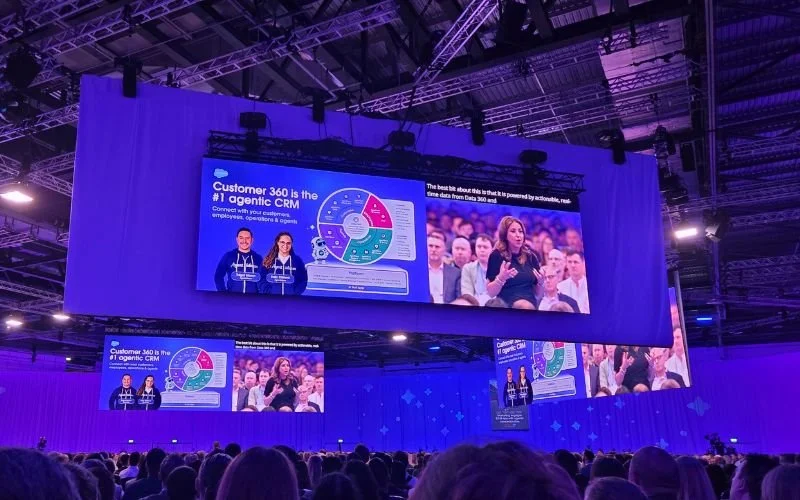
The part we keep coming back to was the Headless 360 demo, and it’s worth diving into.
Headless 360 turns the whole Salesforce platform into something agents and developers can reach programmatically. Every major capability across CRM, Agentforce, Data Cloud and Slack is now available as an API, an MCP tool, or a command line instruction.
In the demo, a user asked a question inside Claude, then the same question inside ChatGPT. Instead of a wall of text, live Salesforce data came back as proper interactive components inside the AI app itself: a record summary, a decision tile, a workflow ready to action. The piece doing that work is the Agentforce Experience Layer. You build the agent logic and the component once, and it renders natively wherever the person already works, whether that is Slack, Teams, a mobile app, ChatGPT, or Claude.
The detail that matters for anyone responsible for a Salesforce org is what travels with that data. The agent inherits your identity, your permissions, your field-level security and your sharing rules. Nothing is bypassed because the request came from outside the browser. That is the difference between a clever demo and something you can actually put in front of customers.
We have been talking to clients about AI readiness for a while now. This demo made that conversation even more relevant. Salesforce is no longer just the system your team logs into. It becomes the trusted source of business context sitting behind whatever agent or app your people use. That changes what good foundations actually look like, and it raises the bar on getting your data and security model right before you scale.
Three announcements worth paying attention to
A few releases stood out for the clients we work with.
Agentic Advisor. Built natively into Agentforce for Financial Services, this targets the admin load that eats a significant portion of a wealth manager or adviser's day, with compliance controls included. Six purpose-built capabilities, with Meeting Concierge generally available now and the rest rolling out through summer 2026. For our financial services clients, this was the most relevant thing on the day.
Slackbot's MCP client is now generally available. Connects more than twenty partner apps into one conversational interface inside Slack. People can work across their stack in plain language without switching tools.
The Fin acquisition. Days before the event, Salesforce confirmed it is acquiring Fin, formerly Intercom, for approximately $3.6 billion (around €3.1 billion), adding a proven customer service agent platform to Agentforce. The deal is expected to close in early 2027. Fin is Irish-founded, and this has been called the biggest exit for an Irish-founded tech firm. Worth noting if you follow the Irish tech market closely.
Two things that deserved more airtime
Two points from the day did not get the attention they warranted.
The skills gap. Salesforce's own research is clear: a large share of UK workers have had no formal AI training from their employer, despite many already using AI in their daily work. The technology is moving faster than the people expected to use it. Adoption is not the hard part anymore – readiness, governance and security are.
The pricing shift. Agentforce is moving from per-seat licensing toward consumption-based pricing using Flex Credits. That changes the business case. You stop paying for seats that go unused and start paying for the work agents actually do. Which makes it far more important to know, up front, which agent tasks earn their keep and to have governance in place before costs start to scale. Learn more about Agentforce pricing here.
What we took away
Both points land on the same truth, and it is the one we built capeMBX around. The platform is rarely the hard part. Getting value out of it is.
Most Salesforce projects underdeliver because nobody owns value realisation after go-live. The agentic era raises the stakes on that. An agent with access to your data and your customers is only as good as the data, the guardrails and the adoption sitting behind it.
Headless 360 is a genuine step forward. It also means more surface area, more places an agent can act, and more reasons to get the foundations right before you scale. If you are weighing up where agents fit in your Salesforce setup, or whether your data is actually ready for them, that is a conversation worth having before the licences are signed, not after.
If that is on your mind, we would be glad to talk it through.
