

Create Teams That Drive Salesforce Success in 2026
The ability to create teams effectively determines whether Salesforce implementations deliver transformational value or become expensive disappointments. Organisations investing substantial resources into CRM platforms often overlook the critical human element: assembling the right mix of skills, roles, and personalities to drive adoption and extract maximum value.
Within the Salesforce ecosystem, team composition directly impacts user engagement, data quality, process optimisation, and ultimately, return on investment. Understanding how to create teams that align with both technical requirements and business objectives separates successful implementations from those that struggle to gain traction.
The Foundation of Effective Salesforce Teams
When you create teams for Salesforce initiatives, the structure must reflect both the platform's capabilities and your organisation's unique requirements. A well-constructed team typically includes business analysts who translate requirements, developers who build custom functionality, administrators who maintain system health, and executive sponsors who champion adoption.
The composition varies significantly based on implementation scope. Small businesses might create teams with dual-role members, whilst enterprises require specialists across multiple Salesforce clouds. Building high-performing teams requires unified vision, effective communication channels, and adaptability to evolving business needs.
Core Roles and Responsibilities
Successful Salesforce teams balance technical expertise with business acumen:
Business Analysts bridge the gap between stakeholders and technical teams, documenting requirements and validating solutions
Salesforce Administrators handle day-to-day configuration, user management, and system maintenance
Developers create custom applications, integrations, and complex automation when declarative tools reach limitations
End Users provide frontline feedback and champion adoption within their departments
Project Managers coordinate timelines, resources, and stakeholder communications

Strategic Approaches to Team Building
To create teams that deliver sustainable results, organisations must consider both immediate project needs and long-term platform stewardship. The approach differs markedly between greenfield implementations and optimisation projects for existing Salesforce environments.
Initial Implementation Teams require heavy business analysis and change management focus. These teams spend considerable time understanding current processes, designing future states, and preparing organisations for transformation. Strategies for building high-performing teams emphasise clear vision, trust, and shared leadership during these critical phases.
Ongoing Support Teams shift focus toward continuous improvement, user enablement, and technical debt management. When organisations choose between managed services and in-house teams, they must weigh control against expertise and resource availability.
Balancing Internal and External Resources
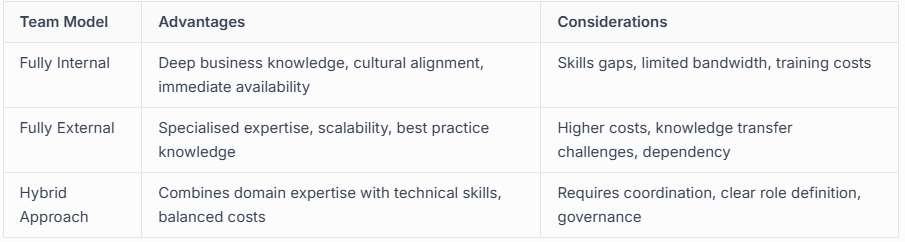
Organisations increasingly create teams using hybrid models, particularly when implementing sophisticated capabilities like Agentforce or integrating Data Cloud. This approach provides access to specialised skills whilst building internal capabilities over time.
Building Team Capabilities for Modern Salesforce
The Salesforce landscape in 2026 demands teams comfortable with AI integration, automation frameworks, and multi-cloud architectures. When you create teams today, technical literacy extends beyond traditional CRM administration to include data science fundamentals, API design, and user experience principles.
Tech leaders building sustainable teams must balance growth with wellbeing. This proves particularly relevant for Salesforce teams managing increasing complexity without proportional resource expansion.
Essential Skills for 2026
Modern Salesforce teams require diverse competencies:
AI Readiness: Understanding how AI agents augment human workflows and when automation provides genuine value versus complexity
Integration Architecture: Connecting Salesforce with enterprise systems through APIs, middleware, and data synchronisation
Industry Knowledge: Applying sector-specific best practices, whether in financial services, insurance, or other verticals
Change Management: Driving user adoption through training, communication, and process redesign
When organisations assess their AI readiness, team capabilities feature prominently alongside technical infrastructure and data quality considerations.

Structuring Teams Around Methodology
The way you create teams should align with your chosen implementation methodology. At capeMBX Consulting, the BEACON methodology structures teams around discovery, design, development, deployment, and ongoing optimisation phases, ensuring appropriate skills engage at relevant stages.
Phase-Specific Team Composition
Different project phases require varying team emphasis. Discovery phases demand strong business analysts and stakeholder interviewers. Development phases increase developer and administrator involvement. Deployment phases bring change management specialists and super users to the forefront.
Strategic decisions during Salesforce implementation include determining when to create teams with permanent members versus flexible, phase-based composition. Both approaches offer merits depending on organisational structure and project complexity.
Optimising Team Performance and Collaboration
Creating effective teams extends beyond initial composition to fostering collaboration, knowledge sharing, and continuous improvement. High-performing Salesforce teams establish clear communication protocols, leverage collaboration tools like Slack, and maintain comprehensive documentation.
Knowledge Management becomes critical as teams grow and evolve. When team members transition, organisations with robust documentation and knowledge transfer processes maintain momentum. Teams implementing Service Cloud case management or complex automations particularly benefit from thorough technical documentation.
Continuous Learning separates stagnant teams from those delivering increasing value. Salesforce's rapid release cycle demands teams stay current with new features, deprecated functionality, and evolving best practices. Salesforce learning resources provide structured pathways for skill development across roles.

Measuring Team Effectiveness
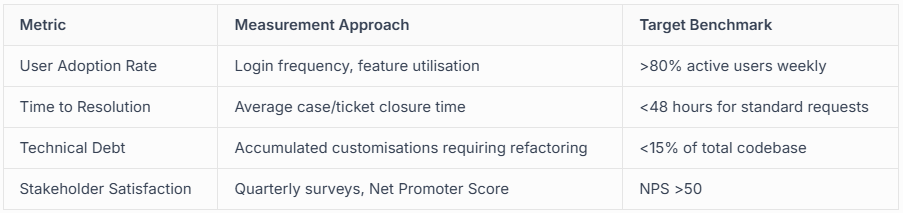
Regular assessment helps teams identify improvement opportunities and validate their contribution to business objectives. When organisations create teams without clear success metrics, accountability suffers and value becomes difficult to demonstrate.
Scaling Teams for Growth
As Salesforce footprints expand, organisations must create teams capable of supporting increasing user bases, additional clouds, and more sophisticated use cases. Scaling requires thoughtful planning around specialisation, governance, and knowledge distribution.
Centre of Excellence Models provide governance frameworks for larger organisations. These structures create teams focused on standards, architecture, and enablement whilst allowing business units to maintain operational teams addressing specific needs. This approach balances consistency with flexibility.
Succession Planning ensures continuity as team members advance or depart. Organisations dependent on single individuals for critical knowledge face significant risks. Building sustainable teams means deliberately developing depth across key competencies.
Building effective Salesforce teams requires deliberate strategy around role definition, skill development, and collaborative frameworks that evolve with platform capabilities and business needs. When organisations create teams aligned with clear methodologies and measurable outcomes, they transform Salesforce from a collection of features into a genuine competitive advantage.
capeMBX Consulting partners with clients to build high-performing Salesforce teams, leveraging our BEACON methodology to ensure your implementation teams deliver sustainable value and drive measurable business growth.
